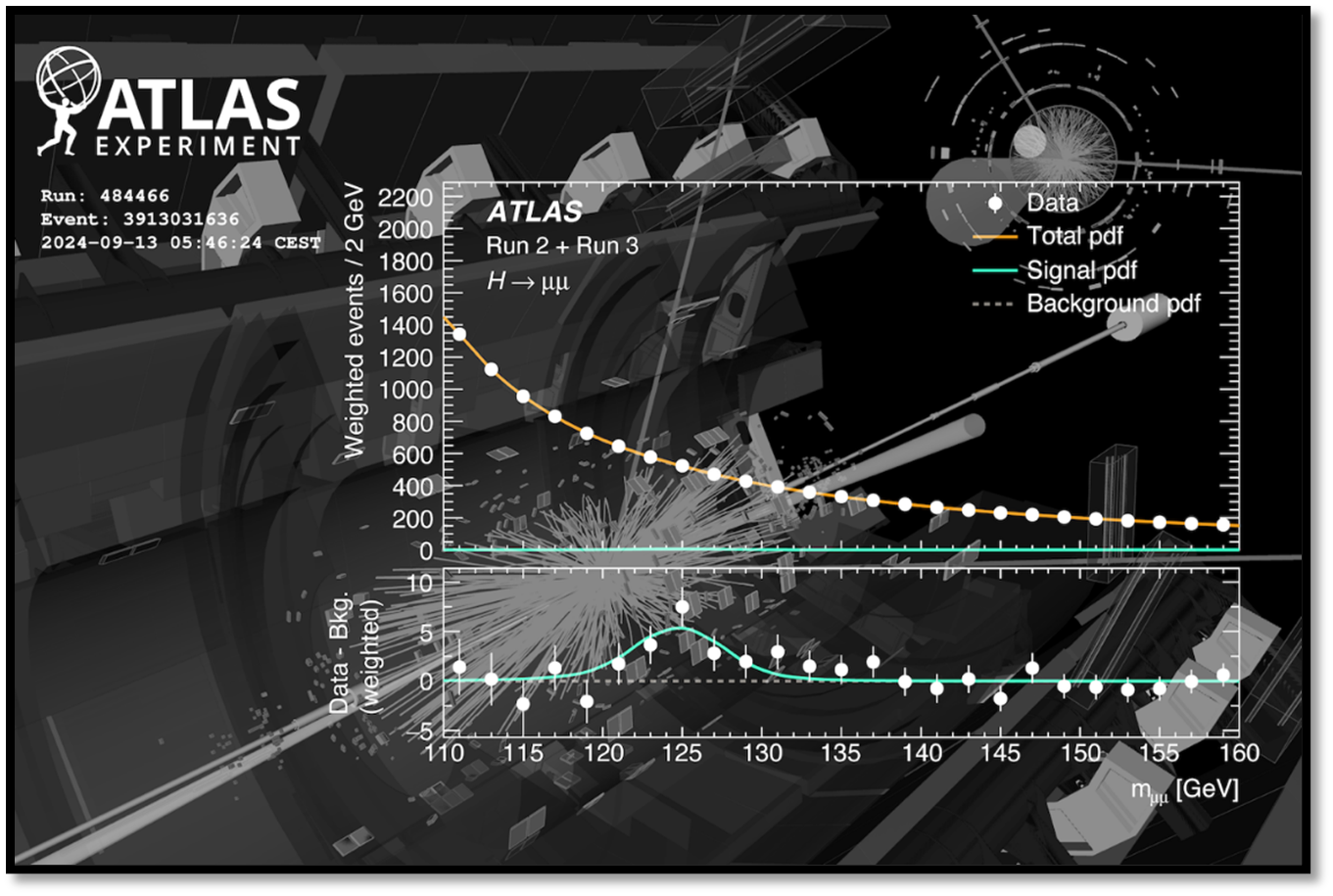





A strange decay of the Higgs boson is observed.
In 2012, CERN announced the historic discovery of the Higgs boson, the last particle of the Standard Model that remained to be discovered. Thirteen years later, it continues to provide us with pleasant surprises and promising results. This December, a study carried out by the ATLAS collaboration at CERN, featuring prominent participation from IFIC, a joint center of the CSIC and the University of Valencia, has been published in the prestigious journal Physical Review Letters. The study identifies a very unusual decay of this subatomic particle.
Specifically, what has been observed at the Large Hadron Collider (LHC) is a decay of the Higgs boson into a muon and an antimuon, that is, a pair composed of a particle and its antiparticle. What makes this observation particularly interesting is the extremely low probability of its occurrence: the process H → μ⁺μ⁻ has only a 0.022% chance of happening (according to the Standard Model). The study of such a rare decay is especially important because it opens a new window onto how the Higgs interacts with second-generation fermions (a group of particles that includes muons, certain types of quarks, and the muon neutrino).
The analysis
This decay mode is the rarest of all the Higgs decay modes observed so far. Previously, the ATLAS collaboration had studied the coupling of the Higgs boson to fermions (a process known as Yukawa coupling), but with heavier fermions. In order to observe the Yukawa coupling to muons, it was necessary to jointly analyze data from Run 2 and Run 3 of the LHC (the LHC runs are its active periods, during which collision data are collected, followed by technical shutdowns). This analysis was particularly challenging because the detector conditions were not stable throughout the entire data-taking period. In particular, both the energy (13 and 13.6 TeV) and the beam intensities changed.
Moreover, identifying such a rare phenomenon is extremely complex. A weak signal must be extracted from an enormous background noise arising from other processes that produce a similar final state. It is like finding a needle in a haystack. Salvador Martí, a CSIC research scientist and member of the IFIC team who participated in and led part of the analysis, explains: «Because the H → μ⁺μ⁻ signal is so weak and the Standard Model background so large, we had to combine all production processes to reach a significance level of 3.4σ and study each process in great detail». An important ingredient of the analysis was the calibration of the muons recorded by ATLAS. Knowing the energies of these particles with very high precision made it easier to identify the phenomenon, as it allowed a small peak corresponding to the H → μ⁺μ⁻ signal to be discerned in the dimuon invariant mass distribution, standing out above the large background. Tamar Zakareishvili, also from IFIC, comments that to achieve good resolution in the muon momentum, «we fine-tuned our calibration extensively by studying the biases we initially had using Z and J/ψ decays to μ⁺μ⁻».
This result, Salvador Martí adds, «represents a further step forward in better understanding the Yukawa coupling in the Standard Model and gaining deeper insight into the structure of matter». We will see what new surprises the Higgs boson brings us in the future.