



IFIC concludes the Complementary R&D&I Plan of the Astrophysics and High-Energy Physics (ASFAE) program with a call to consolidate scientific alliances and strengthen knowledge transfer
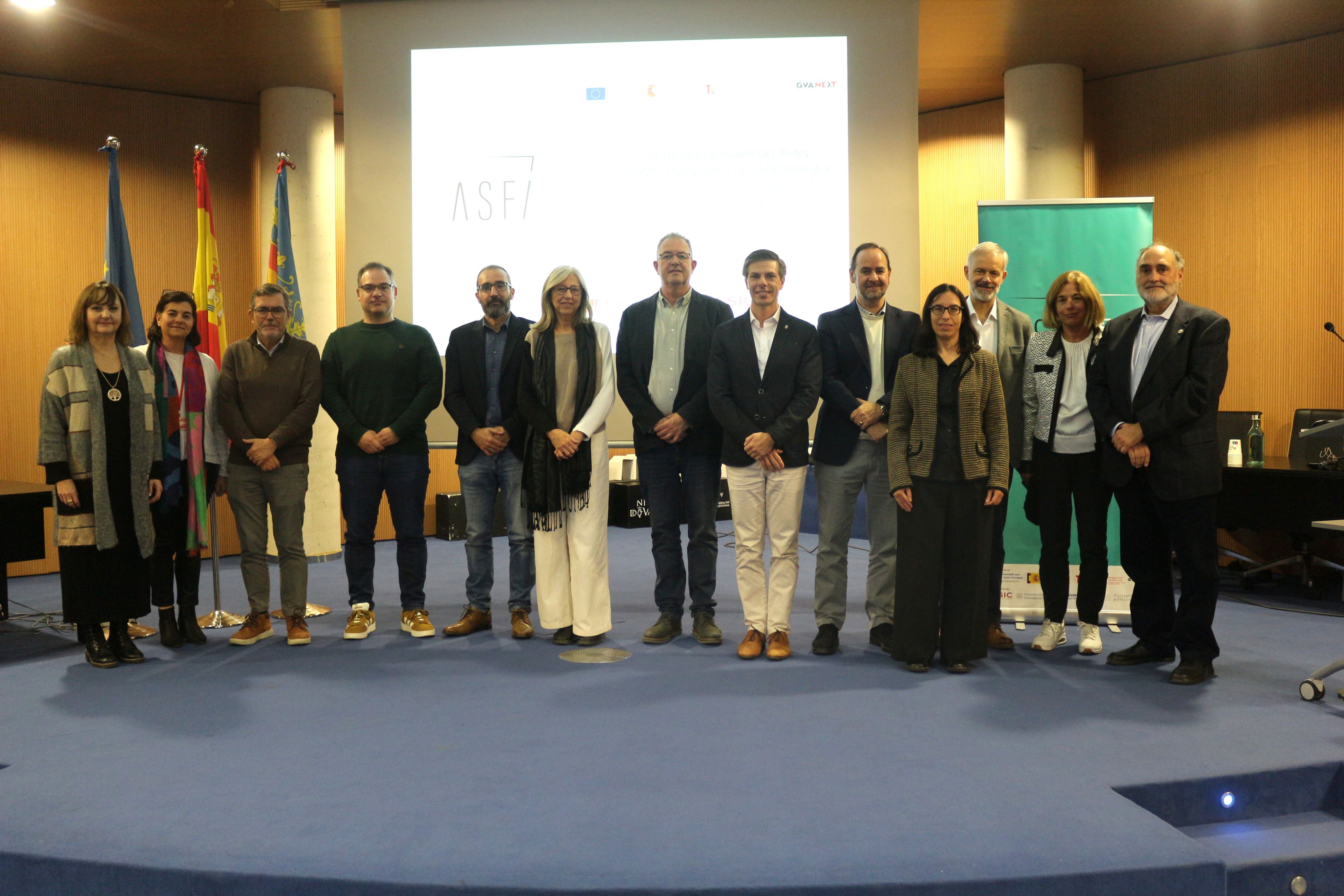
The Corpuscular Physics Institute (IFIC), a joint centre of the Spanish National Research Council (CSIC) and the University of València, held on December 2 the closing ceremony of the Complementary R&D&I Plan of the Astrophysics and High-Energy Physics (ASFAE) program in the Valencian Community. The event, held in the Assembly Hall of the Head Building at the University of València’s Science Park, brought together leading researchers, institutional representatives, and officials from the participating organizations. Attendees included María Esther Gómez Martín, Regional Secretary for Universities of the Generalitat Valenciana; Rafael Sebastián Aguilar, Director General for Science and Research of the Generalitat Valenciana; Nuria Rius Dionís, director of the IFIC; and Jesús M. Salvador, scientific advisor responsible for the complementary plans at the Ministry of Science, Innovation and Universities.
The ASFAE plan in the Valencian Community was launched in March 2023 with the participation of research groups from the CSIC, the University of València (UV), the Polytechnic University of València (UPV), the University of Alicante (UA), the Miguel Hernández University of Elche (UMH) and the IFIC, which served as the regional coordinator. The plan’s main objective has been technological development, as well as the design of instruments necessary to advance the exploration of the universe’s fundamental components and the study of large-scale astrophysical phenomena.
ASFAE is part of the national project “Advanced technologies for the exploration of the universe and its components,” which involves seven autonomous communities: Andalusia, Aragon, the Balearic Islands, Cantabria, Catalonia, the Valencian Community and Madrid.
The Astrophysics and High-Energy Physics program is one of eight priority research areas that both the Spanish Government and the autonomous communities seek to strengthen through the complementary R&D&I plans funded by the Recovery and Resilience Mechanism. The Valencian Community participates in five of these eight areas of scientific and technical interest: marine sciences, quantum communication, agri-food, astrophysics and high-energy physics, and advanced materials.
The program is funded with nearly 38 million euros nationwide, provided by the participating regions and by European funds contributed by the Ministry of Science, Innovation and Universities through the Recovery, Transformation and Resilience Plan, supported by the Next Generation Recovery Fund. Of this amount, 8 million euros were allocated to the Valencian Community—making it the second best-funded region—40 percent of which was contributed by the Generalitat.
Carlos Lacasta, CSIC research professor at the IFIC, served as the scientific coordinator of the plan in the Valencian Community.
A success in coordination and scientific co-governance
The ceremony began with remarks from María Esther Gómez Martín, Regional Secretary for Universities of the Generalitat Valenciana, who emphasized the impact and scale of the program.
From the Ministry of Science, Innovation and Universities, Jesús M. Salvador, scientific advisor responsible for the complementary plans, highlighted that “this plan has been a success at both national and international levels in various aspects: co-financing, collaboration, coordination and co-governance.” He also noted that Spain is “the ninth scientific power” but still has room to grow in knowledge transfer and valorization: “We have the talent, but we must make an effort to promote the creation of spin-offs, more jobs, permanent contracts, and so on. Knowledge transfer can and must be achieved.”
IFIC director Nuria Rius Dionís expressed her gratitude for the support received from the participating institutions and research groups across the Valencian Community. She also stressed the importance of sustaining and building on the scientific capital generated over these years. “This closing ceremony marks a continuation rather than an end. All the collaboration networks created should form the basis for new projects and alliances in the Valencian Community,” she said.
This was followed by a series of presentations on ASFAE, outlining the main scientific and technological objectives and achievements of the project. IFIC’s regional coordinator and research staff shared results ranging from the study of the universe’s largest structures to its smallest components, as well as cutting-edge technologies developed for cancer diagnosis and treatment.
Commitment of the Generalitat to frontier science
In his closing address, Rafael Sebastián Aguilar, Director General for Science and Research of the Generalitat Valenciana, underscored the structural importance of these plans: “The complementary plans have enabled us to make a qualitative leap. They have created internal communication networks as well as networks with other autonomous communities.”
He also proposed maintaining ongoing scientific cooperation: “We would like to organize an internal conference every year, at least,” and noted that ASFAE has opened new strategic research lines that previously did not exist, while also fostering cross-cutting areas such as large-scale data collection and analysis, where the IFIC plays a key role.
The regional official reaffirmed the Generalitat’s commitment to science and knowledge transfer: “The regional government will do everything possible to maintain a high level of funding,” recalling that the future Science Law, expected from 2026 onwards, will be a key instrument in ensuring continuity.
He also announced the continuation of the financial momentum initiated with ASFAE. Between 2026 and 2027, 36 million euros will be allocated to support spin-offs, contracts and new projects linked to strategic scientific fields. Of these funds, 8 million will come from Europe and 24 million from the Endavant Recovery and Reconstruction Plan of the Valencian Community.
A project that strengthens IFIC’s leadership
Finally, it was emphasized that participation in ASFAE has played a decisive role in positioning IFIC research groups “at the forefront of experiments and technologies worldwide,” reinforcing their strategic role in major international collaborations in particle physics and astrophysics.
After the closing session, attendees participated in a networking space that proved particularly enriching for all.
More information:
https://indico.ific.uv.es/event/8305/ (program, Indico)
https://asfaecv.es/ (website, ASFAE)