



IFIC Hosts First National Workshop on Instrumentation for Particle, Astroparticle and Nuclear Physics
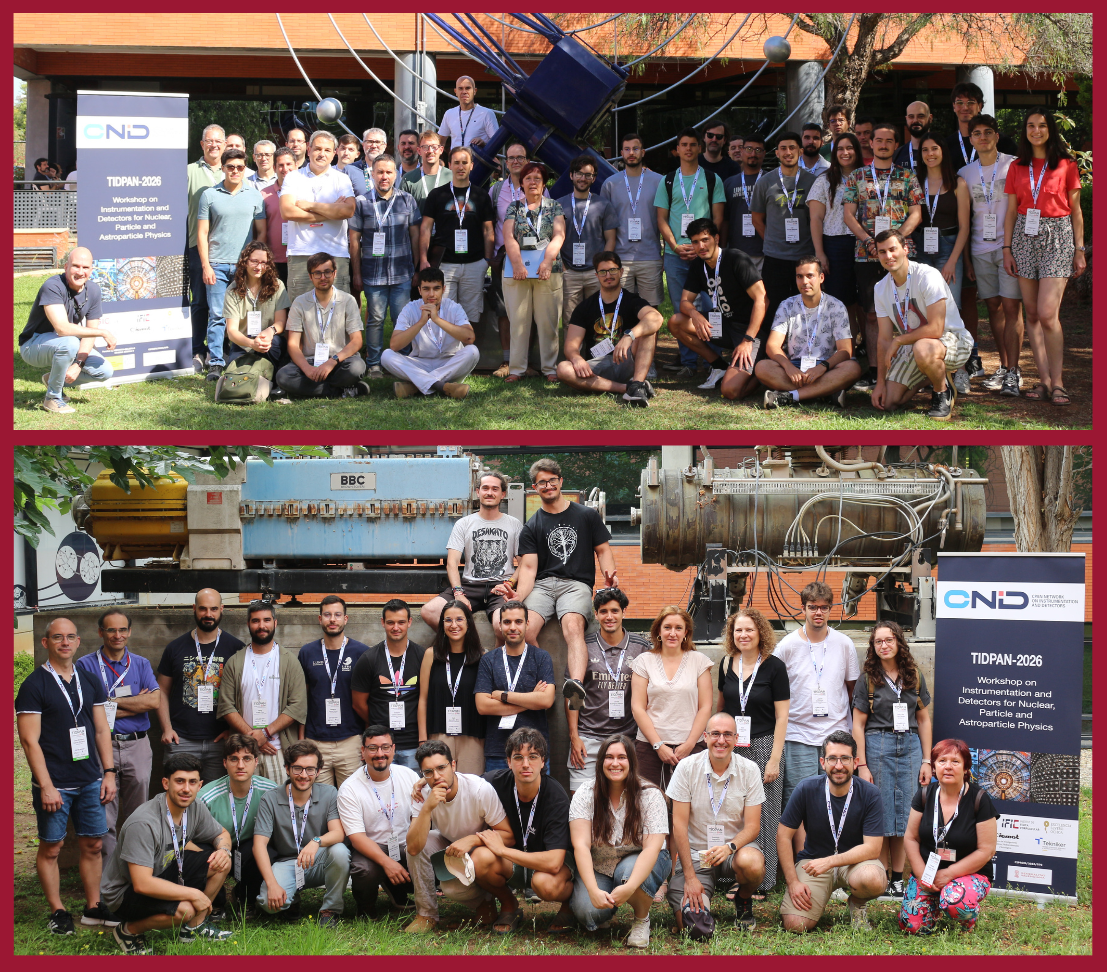
The Institute of Corpuscular Physics (IFIC), a joint research center of the Spanish National Research Council (CSIC) and the University of Valencia (UV), hosted the TIDPAN-2026 Training Workshop (Workshop on Instrumentation and Detectors for Particle, Astroparticle and Nuclear Physics) from June 15 to 26. The initiative, promoted by the Spanish Network for Instrumentation and Detectors in Particle, Astroparticle and Nuclear Physics (CNID), brought together PhD students and technical staff from across Spain to receive training in the most advanced experimental technologies used in modern physics.
The workshop represents the first coordinated national initiative devoted exclusively to training in detectors and instrumentation for the nuclear, particle, and astroparticle physics communities. Its aim is to provide participants with a comprehensive understanding of the technologies underpinning major international scientific experiments while fostering a new generation of young researchers with a shared, solid background in experimental physics.
TIDPAN-2026 was organized by researchers from IFIC, where the workshop took place, together with colleagues from the Institute of Physics of Cantabria (IFCA) and the Centre for Energy, Environmental and Technological Research (CIEMAT), with contributions from experts representing numerous Spanish research institutions. This collaboration reflects the cross-disciplinary nature of the CNID Network and its commitment to training the next generation of specialists in scientific instrumentation.
Over the course of two weeks, early-career researchers from universities and research centers across Spain took part in a program combining lectures delivered by leading experts with intensive hands-on laboratory sessions. The curriculum covered the entire experimental chain, from the physical principles of radiation detection to electronics, data acquisition systems, simulation, and advanced data analysis techniques.
The theoretical sessions covered a broad range of technologies employed in frontier experiments, including tracking and vertex detectors, particle identification systems, muon detectors, calorimeters, instrumentation for dark matter and axion experiments, liquid argon and liquid xenon detectors, and Cherenkov telescopes for high-energy astrophysics, among many other topics.
One of the defining features of TIDPAN-2026 was its strong emphasis on practical training. Participants worked in small groups in IFIC's laboratories, gaining hands-on experience with silicon detectors, silicon photomultipliers (SiPMs), gaseous time projection chambers, gamma spectroscopy systems, neutron detectors, and PET medical imaging technologies, among others. The practical program also included activities on artificial intelligence for signal reconstruction, FPGA-based systems, Monte Carlo simulations, and advanced detector electronics.
Through initiatives such as TIDPAN-2026, the CNID Network strengthens the technological training of young researchers and contributes to consolidating Spain's leadership in the development of detector technologies for major international projects in fundamental physics.