



The new SO-IFIC Colloquium explores the dark Universe with gravitational waves
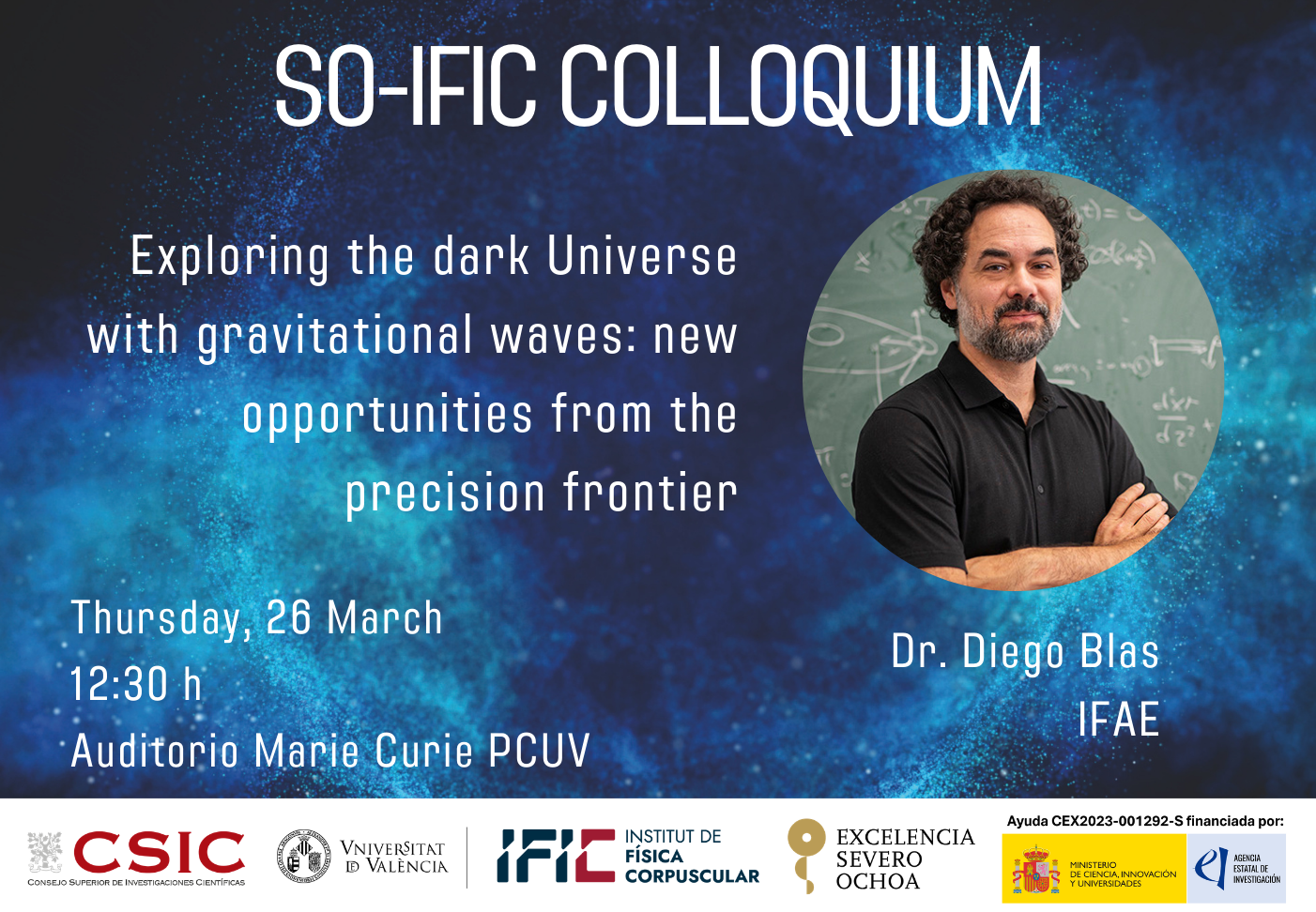
95% of the current energy density of the Universe does not interact with light. Moreover, no light signal can reach us from the origins of the Universe, when it was opaque. The first direct detection of gravitational waves in 2015 opened the door to overcoming these two limitations. These waves can be produced by any sufficiently violent energy source and can travel through the early Universe almost without obstacles.
With this premise, Dr. Diego Blas invites us to “Exploring the Dark Universe with Gravitational Waves: New Opportunities from the Precision Frontier,” a colloquium in which he will describe how gravitational waves of different frequencies provide information about the invisible Universe, from primordial phase transitions to mergers of black holes of different sizes.
He will emphasize which frequency bands are currently underexplored and will show how quantum technologies at the precision frontier and highly accurate astrophysical data may be the key to accessing them. This offers a unique opportunity to unveil the mysteries of the dark Universe!
Dr. Diego Blas was born in Burgos (Spain), but spent his early years in the picturesque town of Benasque. He graduated in Physics from the University of Zaragoza in 2002 and moved to the University of Barcelona to pursue his PhD. During his thesis, he focused on alternatives to General Relativity in an attempt to alleviate the cosmological constant problem.
In 2008, he moved to the École Polytechnique Fédérale de Lausanne (EPFL) in Switzerland. It was at this university that he developed theories of quantum gravity without Lorentz invariance and CLASS, a computer code widely used in modern cosmology. After a few months at New York University, he moved to CERN in 2012, first as a Senior Fellow and in 2014 as a staff member. During this period, he expanded his research toward analytical methods for large-scale structure and new ideas to test dark matter models in astrophysics and with precise (quantum) devices.
In 2018, he joined King’s College London as a Senior Lecturer, and in 2021 he moved to the Universitat Autònoma de Barcelona and the Institute for High Energy Physics (IFAE) as a distinguished Beatriz Galindo researcher. In 2023, he was appointed an ICREA research professor.
On March 26, he will be at IFIC to present his theories on the mysteries of the dark Universe.