




IFIC hosts the KM3NeT Steering Committee meeting
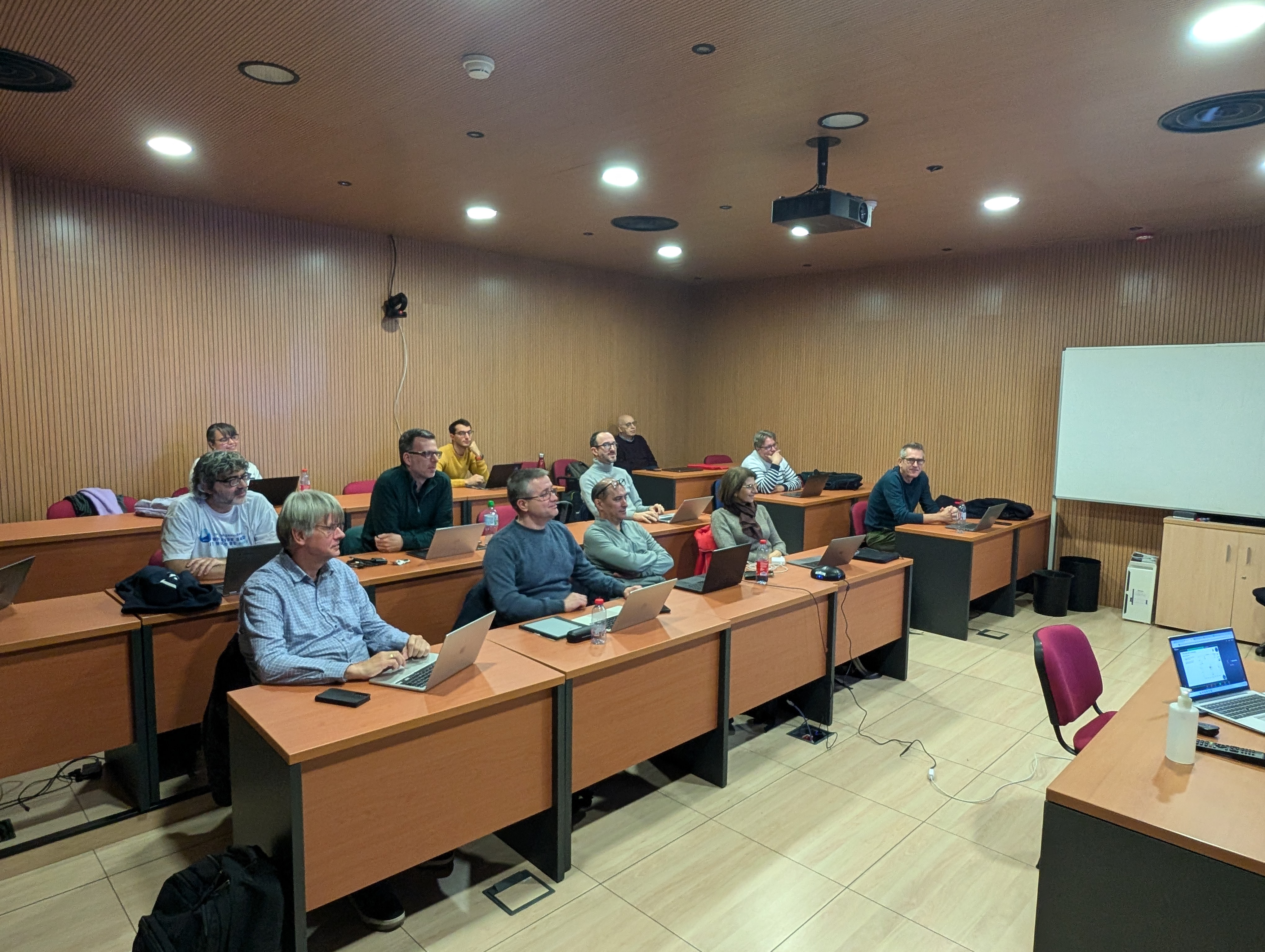
On Wednesday, November 26 and Thursday, November 27, the Institute of Corpuscular Physics (IFIC), a joint centre of the Spanish National Research Council (CSIC) and the University of València, hosted the KM3NeT Steering Committee meeting. During the meeting, representatives from the various partner institutes reviewed progress on the ARCA and ORCA infrastructures and upcoming submarine deployment campaigns. They also discussed advances in production, calibration and data analysis, as well as the medium- and long-term deployment plan for the detectors.
KM3NeT is a research infrastructure housing next-generation neutrino telescopes. Once completed, these telescopes, which are located in the depths of the Mediterranean Sea, will have detection volumes ranging from one megaton to several cubic kilometres of clear seawater. KM3NeT provides a new perspective on our universe while contributing to the study of elusive neutrino particles. KM3NeT scientists use the ARCA telescope to search for neutrinos from distant astrophysical sources, such as supernovae, gamma-ray bursts, or colliding stars. The ORCA telescope, on the other hand, is used to study neutrino properties by observing neutrinos generated in the Earth’s atmosphere. Arrays of thousands of optical sensors detect the faint light produced in the deep sea by charged particles originating from neutrino collisions with the Earth. The facility also hosts instruments for Earth and marine sciences intended for the long-term, real-time monitoring of the deep-sea environment and seabed at depths of several kilometres.
'This meeting has enabled us to coordinate KM3NeT's scientific and technical strategy, as well as strengthening cooperation among the various European centres involved,' says Diego Real, who has coordinated the electronics group since 2013.
IFIC, a founding member of the collaboration, will contribute its expertise in acquisition electronics, sub-nanosecond synchronisation systems, time calibration, modelling, signal reconstruction and various physics analyses.
'It is an honour that the KM3NeT collaboration has placed its trust in me to lead the electronics group of the experiment over the coming years. This will enable IFIC to continue to play a prominent and active role, thereby reinforcing its position as a leading institution in neutrino physics and associated technologies for large-scale scientific infrastructure,' states David Calvo, who was elected as the new coordinator of KM3NeT’s electronics group at the SC.
Construction of KM3NeT is progressing in parallel across its two main infrastructures. The ORCA detector already has 33 operational lines and is collecting data, accounting for around one-third of the total planned. Meanwhile, the ARCA detector currently has 51 operational lines and is expected to have 93 by the end of 2027. Both detectors are expected to be completed around 2030.
The Steering Committee meeting emphasised the international consolidation of KM3NeT and reinforced IFIC’s role in neutrino physics and the development of advanced technologies for large-scale scientific infrastructure projects.
More information:
Website, Valencia Experimental Group of Astroparticles: https://km3net.ific.uv.es/km3net/
Website, KM3NeT: https://www.km3net.org/