


IFIC concludes its IX Summer Student Programme with undergraduate students from across Spain
The Institute of Corpuscular Physics (IFIC), a joint research centre of the Spanish National Research Council (CSIC) and the University of Valencia (UV), has held a new edition of its summer research programme. Through the IFIC Summer Student Programme, participants have the opportunity to experience first-hand what research in particle, astroparticle and nuclear physics is really like, as well as its applications in medical physics and other areas of science and technology.
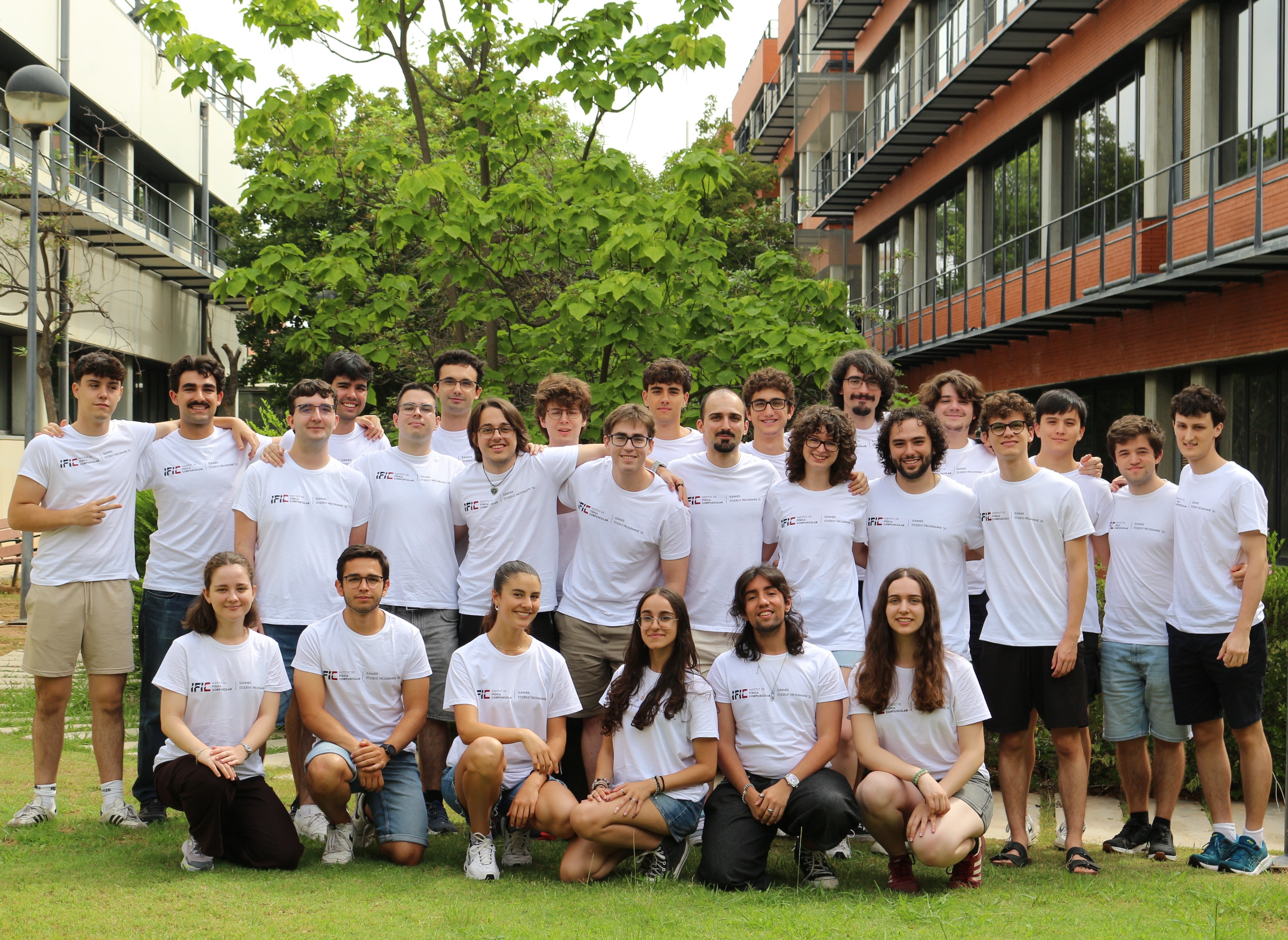
Now in its IX edition, the programme welcomed 27 undergraduate students in Physics, the Double Degree in Physics and Mathematics, and Engineering Physics from universities across Spain and abroad. From 13 to 24 July, participants spent two weeks gaining hands-on experience in cutting-edge experimental physics projects, from data analysis to the development of particle detectors and scientific software.
The programme was organised by Juan Zúñiga and Luca Fiorini, Professors at the University of Valencia; César Domingo, CSIC Research Scientist; Ximo Poveda, CSIC Tenured Scientist; and Arantza Oyanguren, Associate Professor at the University of Valencia. It featured a series of lectures delivered by IFIC researchers, practical workshops, and one-to-one mentoring sessions. Throughout the programme, students also took part in ongoing research projects within the institute's research groups and visited IFIC's laboratories, where advanced technologies are developed for both fundamental research and practical applications in fields such as medical physics and security. “Our aim is not only to introduce them to fundamental research in our field,” explain Zúñiga and Fiorini, “but also to show them the enormous potential of its applications and the impact this research can have on society.”
Among the various activities, the Summer Students 2026 had the opportunity to meet with early-career researchers and PhD students to learn more about how a scientific career begins. They also took part in a workshop on science communication and outreach, jointly organised by the Communication Departments of the Institute of Corpuscular Physics and the Institute of Agrochemistry and Food Technology (IATA).
The programme concluded after two weeks of intensive work, reinforcing IFIC's commitment to training the next generation of physicists. The experience offered participants a close-up view of scientific research while strengthening the preparation of students who have chosen science as their academic and professional path. As the organisers remarked, “We hope this experience has inspired them to pursue a research career in Nuclear and Particle Physics.”