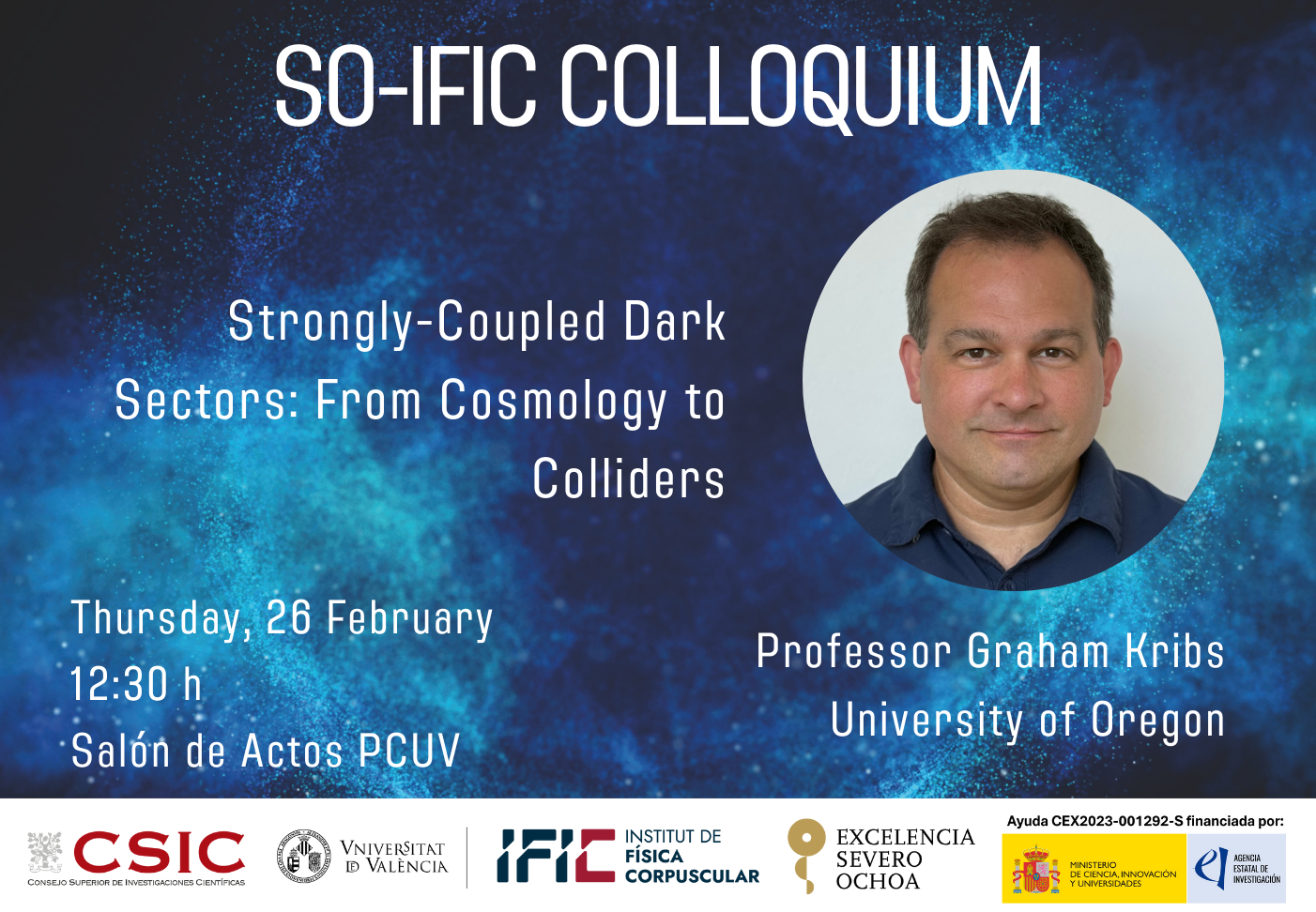




Strongly Coupled Dark Sectors at the Next SO-IFIC Colloquium
Next Thursday, February 26, a new SO-IFIC Colloquium will take place, in which Professor Graham Kribs (University of Oregon) will speak about strongly coupled dark sectors. This type of sector has found applications in various areas of particle physics, from dark matter models to theories addressing the hierarchy problem, and also offers new signals at colliders.
In his talk, Professor Kribs will present an overview of the theory space and of dark matter candidates, before focusing on some simple models that nevertheless exhibit surprising properties for both dark matter and collider physics.
In particular, the elastic scattering cross section, relevant for direct detection experiments, can be strongly suppressed in the case of dark baryons, due to the structure of the theory and the symmetries that survive after confinement. Dark mesons, on the other hand, can be strongly constrained by searches for disappearing tracks, as well as by resonant production and decay processes, the latter arising from an anomaly that had not previously been recognized.
Graham Kribs has been Professor of Physics at the University of Oregon (Eugene, Oregon, USA) since 2005. He is currently on sabbatical at CERN (Theory Group) during the period August 2025–August 2026. He received his Ph.D. in Physics from the University of Michigan in 1998 and subsequently held postdoctoral positions at Carnegie Mellon, the University of Wisconsin–Madison, and the Institute for Advanced Study (Princeton). He was a Ben Lee Fellow at Fermilab (2010–2011) and spent another sabbatical as a Member at the IAS in 2013. Between 2019 and 2025, he served as the first director of the Institute for Fundamental Science at the University of Oregon, which integrated particle physics (theory and experiment), astrophysics (gravitational waves), astronomy, and related areas. He has been a Fellow of the American Physical Society since 2015.
His research in particle physics spans model building and dark matter phenomenology, collider physics, supersymmetry, extra dimensions, Little Higgs theories, primordial black holes, and other topics.
The colloquium will conclude with a discussion of other striking results, in which Professor Kribs will highlight some of the most relevant open questions that still remain to be answered.