


Antonio Jesús Gómez’s doctoral thesis, carried out within the ATLAS group at IFIC, has received the ATLAS Thesis Award for its contributions to the study of the Higgs boson
Antonio Jesús Gómez Delegido’s doctoral thesis, carried out within the ATLAS group at the Instituto de Física Corpuscular (IFIC)—a joint centre of the Consejo Superior de Investigaciones Científicas (CSIC) and the Universitat de València—has been awarded the ATLAS Thesis Award. Entitled Unveiling the Higgs sector with tau-leptons: differential cross-section measurements and searches for lepton-flavor-violating decays with the ATLAS detector, the research received a distinction granted annually by the ATLAS experiment collaboration to the best doctoral theses defended during the previous year, in recognition of their scientific excellence and outstanding contributions to the experiment.
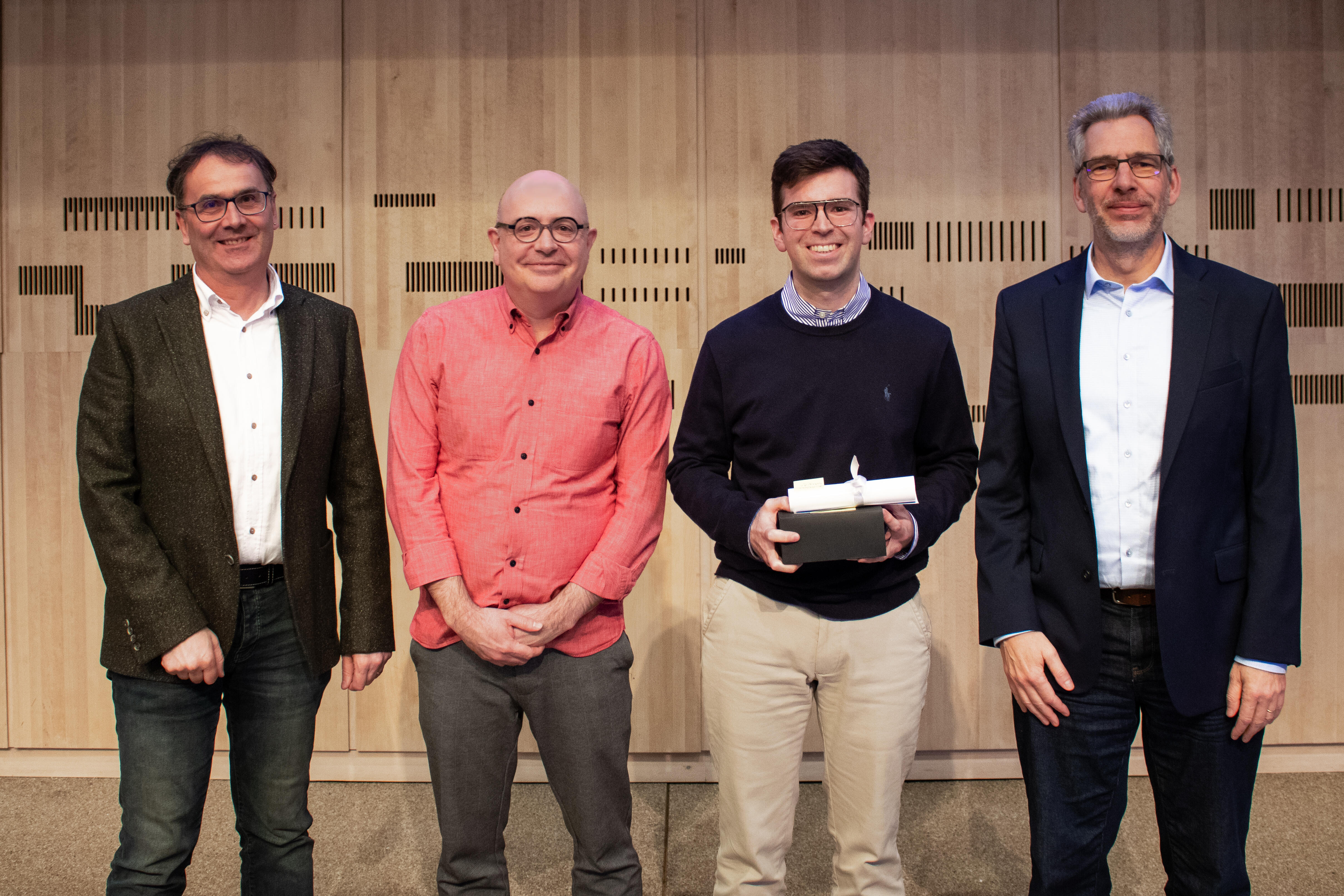
The award ceremony took place on 19 February 2026 at the European Organization for Nuclear Research, CERN, in Geneva (Switzerland), during the plenary session of the ATLAS Collaboration Week. This international meeting regularly brings together members of the collaboration to present results and discuss the latest developments. The award was presented by the ATLAS spokesperson, Stéphane Willocq; the Chair of the Collaboration Board, Davide Costanzo; and the Chair of the ATLAS Thesis Award selection committee, Jean-François Arguin, on behalf of an international committee composed of 16 renowned scientists.
Explanation of the doctoral research
Antonio Jesús Gómez Delegido’s doctoral thesis, entitled Unveiling the Higgs sector with tau-leptons: differential cross-section measurements and searches for lepton-flavor-violating decays with the ATLAS detector, was carried out within the ATLAS group at IFIC under the supervision of Luca Fiorini, Professor at the Universitat de València and researcher at IFIC.
The research focused on a detailed study of the Higgs boson using data from the ATLAS experiment at the Large Hadron Collider (LHC) at CERN. Two main lines of work were pursued. On the one hand, Dr Antonio J. Gómez performed differential measurements of the Higgs boson production cross section in the two tau-lepton decay channel (H→ττ), one of the most sensitive channels for studying the Higgs coupling to leptons and particularly relevant for analysing the vector boson fusion (VBF) production mechanism. These measurements, carried out using the full Run 2 dataset, achieved unprecedented precision in certain kinematic regimes and, for the first time in ATLAS in this channel, provided differential distributions in specific VBF-enriched fiducial regions. They also set limits on possible effects of new physics through an analysis within the framework of effective field theories.
On the other hand, Antonio contributed to searches for lepton-flavour-violating Higgs boson decays, specifically in the H→eτ and H→μτ channels. These decays are not allowed within the Standard Model, and their observation would constitute a clear signal of new physics. The analysis, based on advanced multivariate techniques and the full Run 2 dataset, significantly improved the experimental limits on these processes and strengthened constraints on possible extensions of the Standard Model.
In addition to his major contributions to physics analysis, the thesis included substantial work on the detector, particularly on the ATLAS central hadronic calorimeter (TileCal). Antonio was involved in operation, coordination, and calibration tasks during the start of Run 3, as well as in the development of simulation and reconstruction tools aimed at the future High-Luminosity LHC (HL-LHC) phase, helping to ensure stable and precise detector performance under increasingly demanding conditions.
In the awardee’s words, “receiving the ATLAS Thesis Award represents recognition of the work carried out during my PhD and of the contributions made within the collaboration.” He adds, “This achievement would not have been possible without the training and support received at IFIC and within the collaboration from many colleagues over the years. I look forward to continuing to contribute to ATLAS, both in improving detector performance and in developing increasingly precise measurements that expand our understanding of the Standard Model and its limitations.”
Biography
Antonio Jesús Gómez Delegido (Albacete, 1997) graduated in Physics from the Universitat de València and received the Extraordinary Master’s Award in Advanced Physics. He completed his PhD at the Instituto de Física Corpuscular with FPU funding and defended his thesis in 2025. His research focused on the study of the Higgs boson in the ATLAS experiment at the Large Hadron Collider (LHC), including differential measurements of its production in the two tau-lepton decay channel and searches for lepton-flavour-violating decays. During this period, he contributed to the operation and calibration of the ATLAS central hadronic calorimeter, the Tile Calorimeter (TileCal), as well as to developments related to its upgrade and adaptation to the High-Luminosity LHC (HL-LHC) phase. He is currently a postdoctoral researcher at CERN under a Research Fellow contract. His work focuses on the calibration and performance studies of the TileCal during LHC Run 3 and on preparations for the high-luminosity phase. In addition, he is involved in precision measurements of the Higgs boson through the combination of its different decay channels.
References:
- Link to the doctoral thesis in the CERN repository: https://repository.cern/records/045yg-tnk76
- Article on differential measurements of the Higgs boson production cross section in the two tau-lepton decay channel: JHEP 03 (2025) 010 (ATLAS Briefing)
- Article on searches for lepton-flavour-violating Higgs boson decays: JHEP 07 (2023) 166
- ATLAS news item on the Awards: https://atlas.cern/Updates/News/2025-Thesis-Awards
Main image details:
From left to right: Davide Costanzo, Chair of the ATLAS Collaboration Board; Jean-François Arguin, Chair of the ATLAS Thesis Award selection committee; Antonio Gómez Delegido, award recipient; and Stéphane Willocq, ATLAS spokesperson.