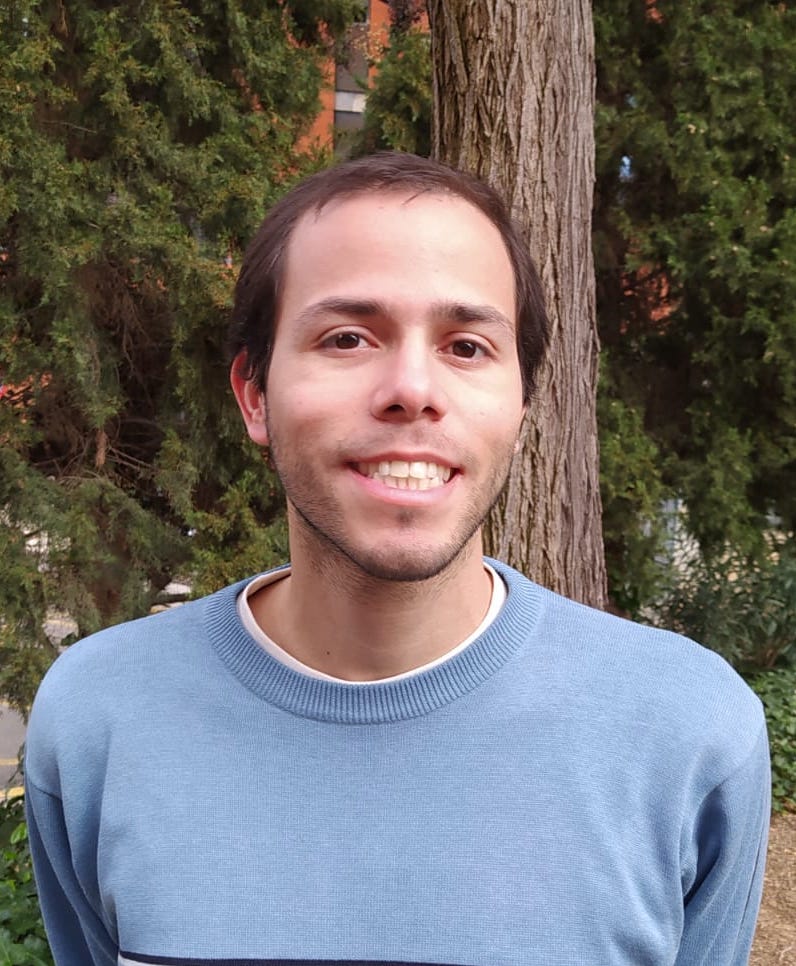



Gustavo Alcalá, postdoctoral researcher at IFIC, receives the award for Best Experimental Doctoral Thesis from the Specialized Group on Nuclear Physics of the RSEF
Gustavo Adolfo Alcalá Escalona, postdoctoral researcher at the Instituto de Física Corpuscular (IFIC), a joint research centre of the Spanish National Research Council (CSIC) and the Universitat de València, has been awarded the prize for Best Experimental Doctoral Thesis in the 2024–2025 edition. The award is granted by the Specialised Group on Nuclear Physics (GEFN) of the Spanish Royal Physics Society (RSEF) and the company ATI Sistemas. His thesis, which received the highest distinction (cum laude) from the Universitat de València in 2024, addresses a fundamental problem in neutrino physics: accurately predicting how many antineutrinos are emitted by a nuclear reactor and at what energies.
Nuclear reactors are an important source of antineutrinos, which are nearly massless elementary particles produced during the beta decay of fission fragments. However, for years, experimental measurements of the antineutrino spectrum have disagreed with theoretical models. This discrepancy is known as the “Reactor Antineutrino Anomaly” (RAA).
Alcalá’s research, supervised by Alejandro Algora, a CSIC research scientist at IFIC, has provided crucial information to improve these predictions by precise measurements of the beta-decay spectra of key isotopes, such as Rubidium-92 (92Rb) and Caesium-142 (142Cs). These isotopes are essential, as their decays contribute significantly to the total antineutrino flux from nuclear reactors.
One of the issues affecting these predictions is the so-called “Pandemonium Effect". Historically, studies of these decays relied on measuring the gamma rays emitted by nuclei after beta decay using germanium detectors. Because these detectors have limited efficiency for detecting high-energy gamma rays, important information was lost, leading to an incorrect assignment of higher beta-decay probabilities to low-energy transitions. This systematic error, present in current nuclear databases, distorts reactor antineutrino spectrum predictions.
To overcome this limitation, this work used e-Shape detectors, designed to directly and precisely measure the energy of electrons emitted in beta decays. By detecting electrons rather than gamma rays, the technique used by Alcalá and Algora is not affected by the Pandemonium effect. These measurements show that high-quality data can be obtained using isotopically pure radioactive beams, allowing nuclear models to be validated and observed anomalies in reactor spectra to be corrected.
The results of the thesis are consistent with previous measurements carried out by the Gamma and Neutron Spectroscopy group at IFIC, which used the Total Absorption Gamma-ray Spectroscopy (TAGS) technique to address the Pandemonium effect from a different perspective.
These findings are the result of work carried out within the international e-Shape collaboration, involving leading institutions such as IFIC itself, Subatech Nantes (France), the University of Warsaw (Poland), and the University of Surrey (United Kingdom). The results of this thesis were recently published in Physical Review Letters, highlighting the international impact of the research conducted at IFIC.
Gustavo Alcalá currently continues his work at IFIC as a postdoctoral researcher, focusing on improving analysis techniques to further unravel the mysteries of nuclear interactions and their application in improving the safety and efficiency of nuclear reactors.
Reference: https://journals.aps.org/prl/abstract/10.1103/hyj7-l22h