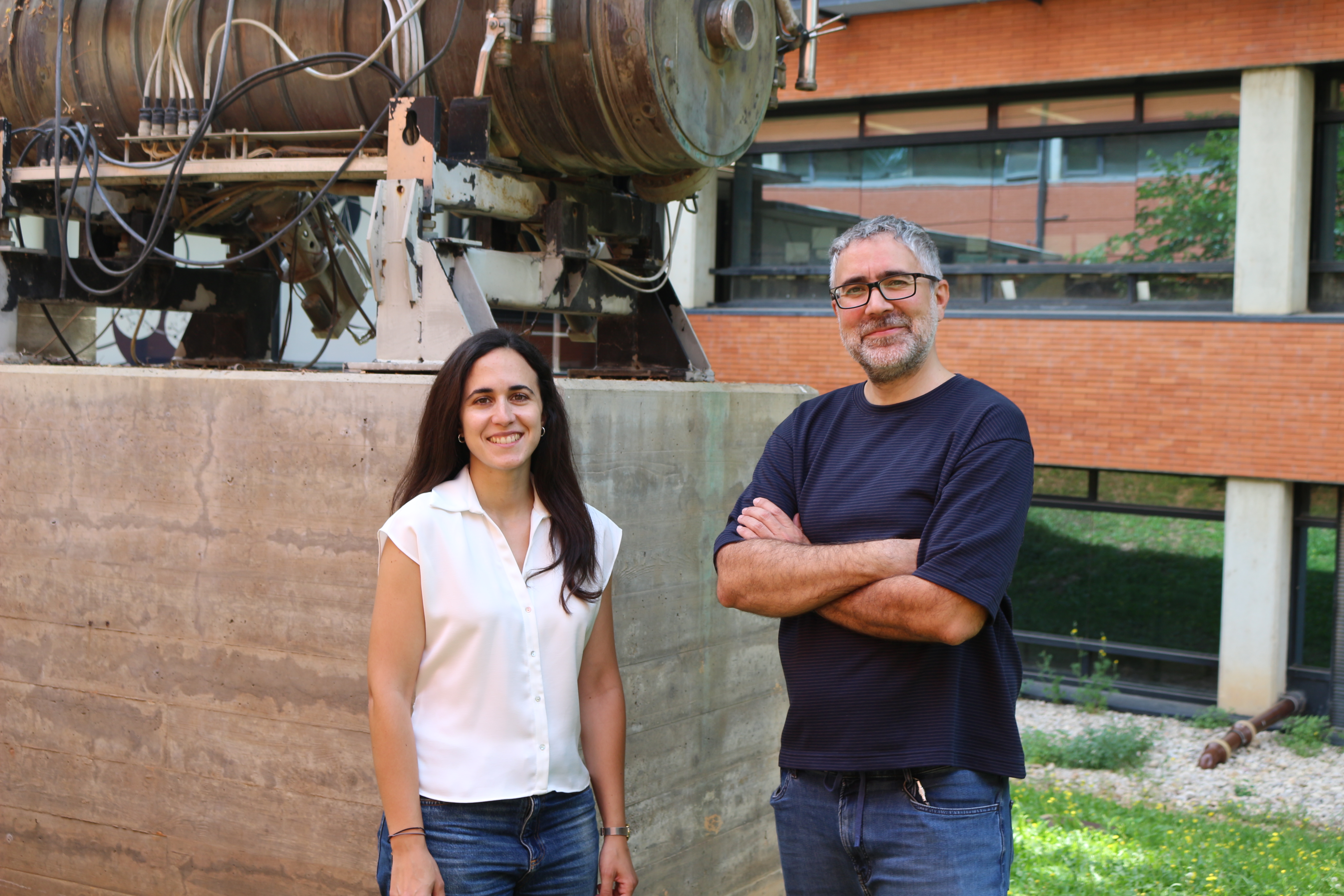





The IFIC (CSIC-UV) contributes to collecting the world's largest dataset of B mesons with the Belle II experiment, and Cristina Castro is appointed chief engineer for its upgrade
Belle II is an experiment conducted at the SuperKEKB electron-positron collider, located in the city of Tsukuba, Ibaraki Prefecture, Japan. The experiment is designed to search for new physics beyond the Standard Model. The Belle II collaboration consists of more than 1,200 members from 28 countries and regions. The University of the Basque Country (EHU) and the IFIC (CSIC-UV) are the only participating centers from Spain.
Its physics program focuses on precision studies of heavy quarks and leptons—a field known as 'flavor physics'—through extremely rare and experimentally complex processes. By comparing high-precision measurements with theoretical predictions, Belle II aims to uncover potential signs of new particles or forces beyond current theories.
Recently, the experiment achieved a major milestone by surpassing the total data volume accumulated by its predecessor, Belle. Concurrently, Cristina Castro Sequeiro, a researcher at IFIC, has been appointed head of mechanical design and integration for the upgrade of Belle II and SuperKEKB.
Record luminosity
Belle II studies the collisions produced at SuperKEKB, which collides electrons and positrons at high energy. These collisions produce, among other particles, pairs of B mesons and anti-mesons, whose behavior is of great interest for testing the Standard Model of particle physics with high precision. To analyze this behavior, it is essential to accumulate an immense amount of experimental data, and 'luminosity' is the key indicator of this data volume.
The luminosity of a collider is a quantity proportional to the number of collisions it is capable of producing. It is a vital metric for colliders because the higher the luminosity, the greater the chances of finding rare events, which are essential for discovering new phenomena in nature. SuperKEKB was designed to achieve record luminosities thanks to its nano-beam collision scheme, which significantly increases the number of collisions by utilizing extremely small beams at the collision point.
Belle, the predecessor to Belle II which operated from 1999 to 2010, recorded 772 million B meson pair data points over its lifetime, corresponding to an integrated luminosity of 711 fb-1 (inverse femtobarns). In its time, Belle played a crucial role in describing CP violation in quarks through the Standard Model, leading discoveries that contributed decisively to the 2008 Nobel Prize in Physics awarded to Makoto Kobayashi and Toshihide Maskawa.
On May 17, Belle II reached a milestone in its data production: it surpassed Belle in the total number of collected collisions. As of June 4, Belle II had reached an integrated luminosity of 862 fb-1, and it continues to grow. This milestone comes during a period marked by record instantaneous luminosities, sustained high-efficiency data taking, and continuous improvement, which have allowed Belle II to achieve a data collection rate three times faster than its predecessor.
Carlos Mariñas, a researcher at IFIC and deputy spokesperson for the experiment, explains the significance of this milestone and IFIC's role in its development:
"We have reached a milestone by surpassing the total amount of data collected by the original Belle project with the new experiment. IFIC plays a fundamental role in this historic achievement, which takes us deep into uncharted territory in the search for new physics. Our team has not only actively participated in the development of the current detector and the optimization of data taking, but we are also leading the developments for the experiment's upgrade scheduled for the early 2030s."
The strong performance of Belle II holds large-scale importance, as electron-positron collisions are the most promising regarding the discovery of new physics. Precisely for this reason, the recently updated European Strategy for Particle Physics has established a large collider of this type—the Future Circular Collider (FCC-ee)—as the preferred option for the next major project at CERN. The advanced instrumentation expertise developed for Belle II will be of great value when bringing projects of this scale to fruition.
"The experience gained from the design and operation of the Belle II experiment in a particle accelerator with nano-beams and high currents like SuperKEKB also allows IFIC to position itself in a leadership role for the experimental developments destined for the Higgs factory, the next major project in international particle physics."
The current data-taking run of SuperKEKB and Belle II is scheduled to continue until the end of June and will resume after the summer. It is expected to soon surpass the figure of 1,000 fb-1 of integrated luminosity.
Cristina Castro, from IFIC, appointed chief engineer
The high performance achieved requires exceptionally stable accelerator operation at high luminosity, which is a major engineering challenge within the collaboration. To accomplish this, it is necessary to produce high-intensity electron and positron beams with the linear accelerator, inject them efficiently into the main rings through the injector system, and precisely adjust and control these beams within the main rings. Stability has been limited by sudden beam loss phenomena, in which a fraction of the beam is lost with little or no prior warning. These previously unknown challenges have been gradually resolved, enabling sustained operation close to the new instantaneous luminosity record.
An upgrade of SuperKEKB and Belle II is planned for 2032 as part of a long technical shutdown that will further increase its efficiency and will also pose a major technical challenge. IFIC researcher Cristina Castro Sequeiro will be in charge of leading these operations.
Her responsibilities will include project planning and the mechanical integration of the detector systems. This is a position of enormous responsibility that she takes on with great motivation:
"The Belle II upgrade will involve a restructuring of the detector, directly impacting the future capabilities of the experiment. Leading this upgrade represents not only a very interesting technical challenge, but also a major responsibility at a key stage in the detector's development. It is a unique opportunity, made possible by IFIC's expertise and involvement in the project. I appreciate the collaboration's trust in selecting me for this position, and I face this new challenge with enthusiasm and a strong commitment to making the upgrade a success."
She will need to collaborate closely with those responsible for the accelerator and detector upgrades to ensure full compatibility between designs, as well as coordinate contributions from the various institutes within the collaboration:
"My role encompasses the mechanical design of various detector components, including structural and thermal aspects, the integration of new subsystems both within the detector and with adjacent accelerator systems, as well as project management. It is a complex job that requires continuous collaboration among the different groups involved."
Cristina's appointment highlights the significant work that IFIC has been carrying out in Belle II, which is certain to yield great results in the future.