


The IFIC hosts a workshop on nuclear data needs for antineutrino spectrum calculations and their applications
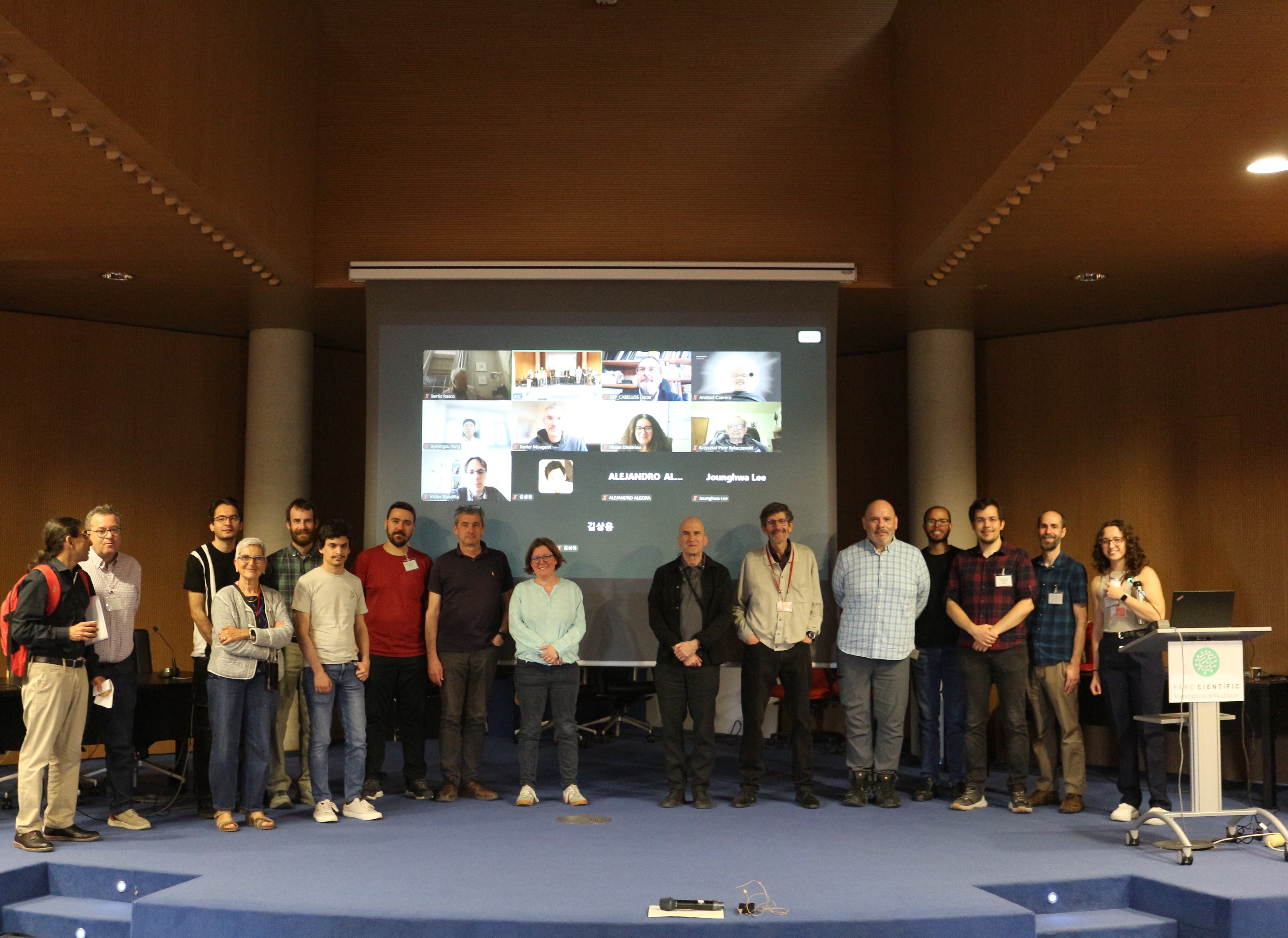
The Instituto de Física Corpuscular (IFIC), a joint center of the Consejo Superior de Investigaciones Científicas (CSIC) and the Universitat de València, hosted the workshop “Nuclear Data Needs for Antineutrino Spectra and their Applications” from May 4 to 8.
The aim of the workshop was to address the current status of reactor antineutrino flux and spectrum measurements and their comparison with model predictions. Although significant experimental and theoretical advances have been achieved over the last two decades, the foundations of reactor antineutrino flux models still rely on the integrated beta spectrum measurements carried out by Schreckenbach and collaborators at the Institut Laue-Langevin (ILL) in the late 1980s. More recent measurements of the 235U/239Pu beta spectrum ratio, conducted by Kopeikin and collaborators at the Kurchatov Institute, have revealed discrepancies of approximately 5%, suggesting possible normalization issues in the original ILL data.
The workshop covered several topics of major interest, including advances in beta decay measurements relevant to this issue and their impact on summation models, recent measurements and future plans related to reactor antineutrino spectrum studies, the impact of recent fission yield measurements, and the possibility of new measurements of the aggregate beta spectra of actinides.
The organization of the workshop was led by IFIC researcher Alejandro Algora: “The fact that the workshop was held in Valencia is recognition of the work carried out by the IFIC Gamma and Neutron Spectroscopy Group in this field,”
commented Algora, noting that the group makes significant contributions to precise beta decay measurements relevant to reactor antineutrino spectrum calculations. The organizing committee also included José Luis Taín, Paraskevi Dimitriou, Gustavo Alcalá, and Celia Lupi.
The workshop was held in collaboration with the International Atomic Energy Agency (IAEA), the world’s central intergovernmental forum for scientific and technical cooperation in the nuclear field, whose mission is to promote the safe and peaceful use of nuclear technologies. The event brought together 35 participants from the United States, South Korea, China, and several European countries. The scientific program featured presentations followed by roundtable discussions that enabled extensive debate and scientific exchange.
More information about the event is available: here.