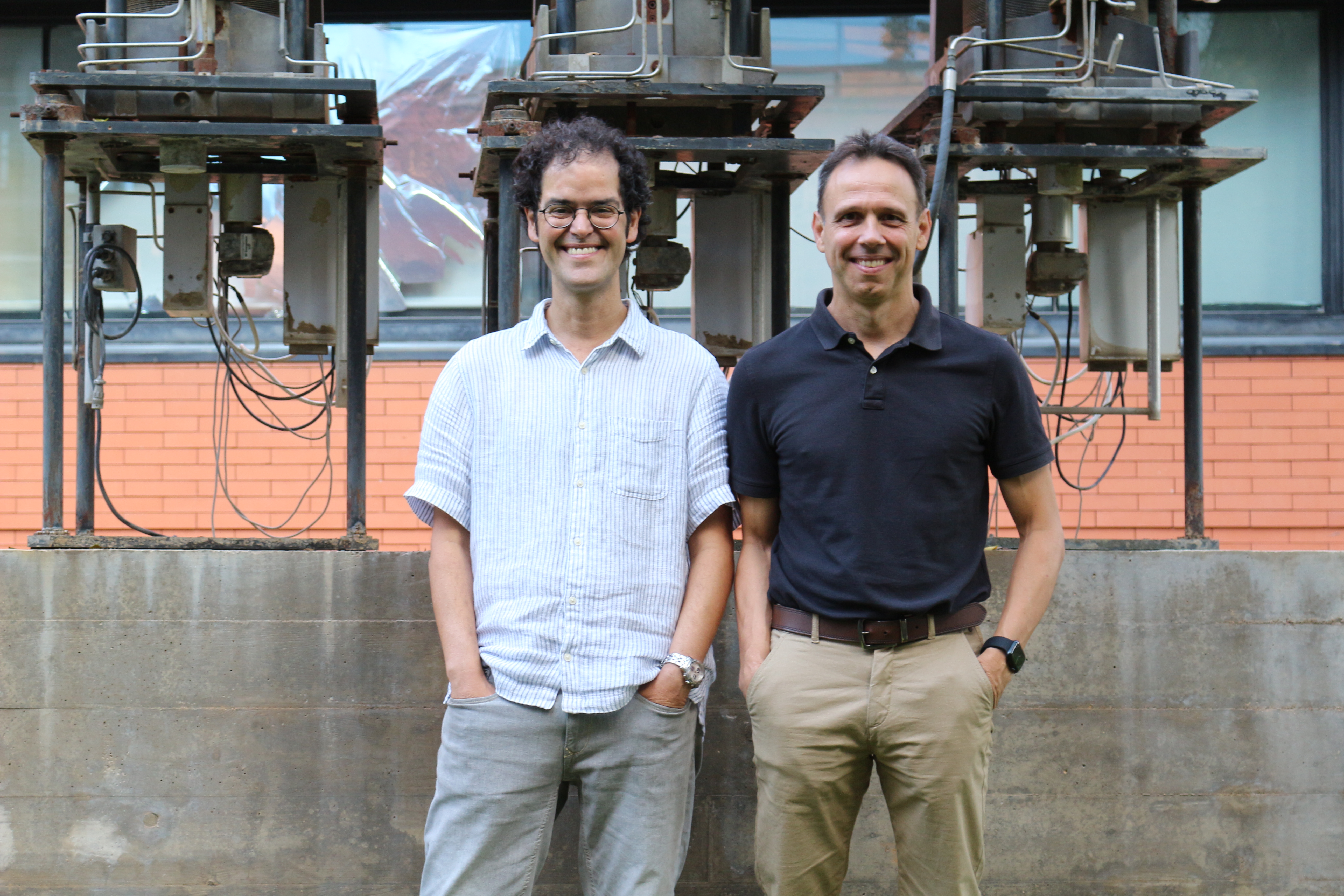




Iván Agulló and Jorge Peñarrubia join IFIC through the ValER call to advance research into quantum technologies and dark matter
The Institute of Corpuscular Physics (IFIC), a joint centre of the Spanish National Research Council (CSIC) and the University of Valencia (UV), has welcomed two researchers through the ValER call, which offers permanent positions to researchers wishing to pursue a long-term scientific career in the Valencian Community. Iván Agulló has joined IFIC through the University of Valencia, while Jorge Peñarrubia has joined through the CSIC.
Jorge Peñarrubia: making dark matter visible through gravity
Jorge Peñarrubia is a theoretical astrophysicist whose research focuses primarily on the dynamics of gravitational systems and the study of dark matter through its gravitational effects. He obtained his PhD in Astrophysics from Heidelberg University (Germany) and subsequently continued his career at the University of Victoria (Canada), the University of Cambridge (United Kingdom) and the University of Edinburgh (United Kingdom).
His research at IFIC will focus on studying the nature and distribution of dark matter through its gravitational effects. The aim is to search for signals that could reveal dark matter structures that do not emit light and to determine how dark matter is distributed across different astrophysical systems.
The project will mainly revolve around two lines of research: first, the detection of dark subhaloes through their gravitational effects on visible objects; and second, the distribution of dark matter in the Solar System. Both lines share the same underlying idea: using gravity to make visible what we cannot observe directly.
Peñarrubia highlights that joining IFIC represents an opportunity to work at an institute where particle physics, cosmology and astrophysics converge. “IFIC offers an ideal environment in which to combine gravitational dynamics, statistical methods and fundamental physics, and to take advantage of the new astronomical observations that will become available over the coming years.”
Iván Agulló: at the interface between quantum information, gravity and quantum technologies
Iván Agulló obtained his PhD in Physics from the University of Valencia in 2009. After postdoctoral positions at the University of Wisconsin–Milwaukee and Pennsylvania State University (USA), and a Marie Curie Fellowship at the University of Cambridge (United Kingdom), he joined Louisiana State University in 2013, where he is a professor, and has been a Visiting Fellow at the Perimeter Institute since 2023. He is now joining IFIC to develop a research programme in the field of quantum science and technologies and their intersection with quantum field theory and gravitation. “Valencia, where I obtained my PhD, now brings together a remarkable critical mass in quantum science and technologies, as well as a network of European collaborators, making it the natural place to develop my research,” he says.
His work lies at the intersection of quantum information, quantum field theory and gravitation, and deliberately covers a broad spectrum: relativistic and non-relativistic quantum information, quantum technologies and their industrial applications, quantum field theory in curved spacetimes, analogue gravity, quantum cosmology, black hole physics, and quantum gravity phenomenology using gravitational waves.
On the applied side, Agulló has collaborated on the distribution of entanglement via satellites and its use for secure clock synchronisation using quantum resources, a technology with applications in navigation, telecommunications and metrology. His profile is also strongly international. He is a Council Member for the Americas of the International Society for Relativistic Quantum Information (ISRQI), and serves on the Steering Board of the International Society for Loop Quantum Gravity and on the editorial board of the journal General Relativity and Gravitation (Springer).
Two appointments that expand IFIC’s scientific capabilities
These two appointments strengthen IFIC’s research staff, expanding and enhancing its scientific capabilities and consolidating its position as a leading centre for cutting-edge research in physics.