




'Nature' publishes the most precise calculation of the strong coupling constant, with participation from IFIC
On Thursday, April 9, the prestigious journal Nature publishes the most precise determination to date of the strong coupling constant, the parameter that governs the interactions between quarks and gluons—fundamental components of nuclear matter. The study, the result of a European collaboration, includes the participation of Alberto Ramos, a researcher at the Instituto de Física Corpuscular (IFIC), a joint center of the Spanish National Research Council (CSIC) and the University of València.
The result doubles the precision of all previous experimental measurements combined, establishing the most accurate reference value for this parameter of the Standard Model. This improvement will allow a more precise characterization of the interaction between quarks, with direct implications for both theoretical physics and the interpretation of data from the Large Hadron Collider (LHC) at CERN. In turn, it will impact precision studies of the Higgs boson and searches for physics beyond the Standard Model.
The strong interaction
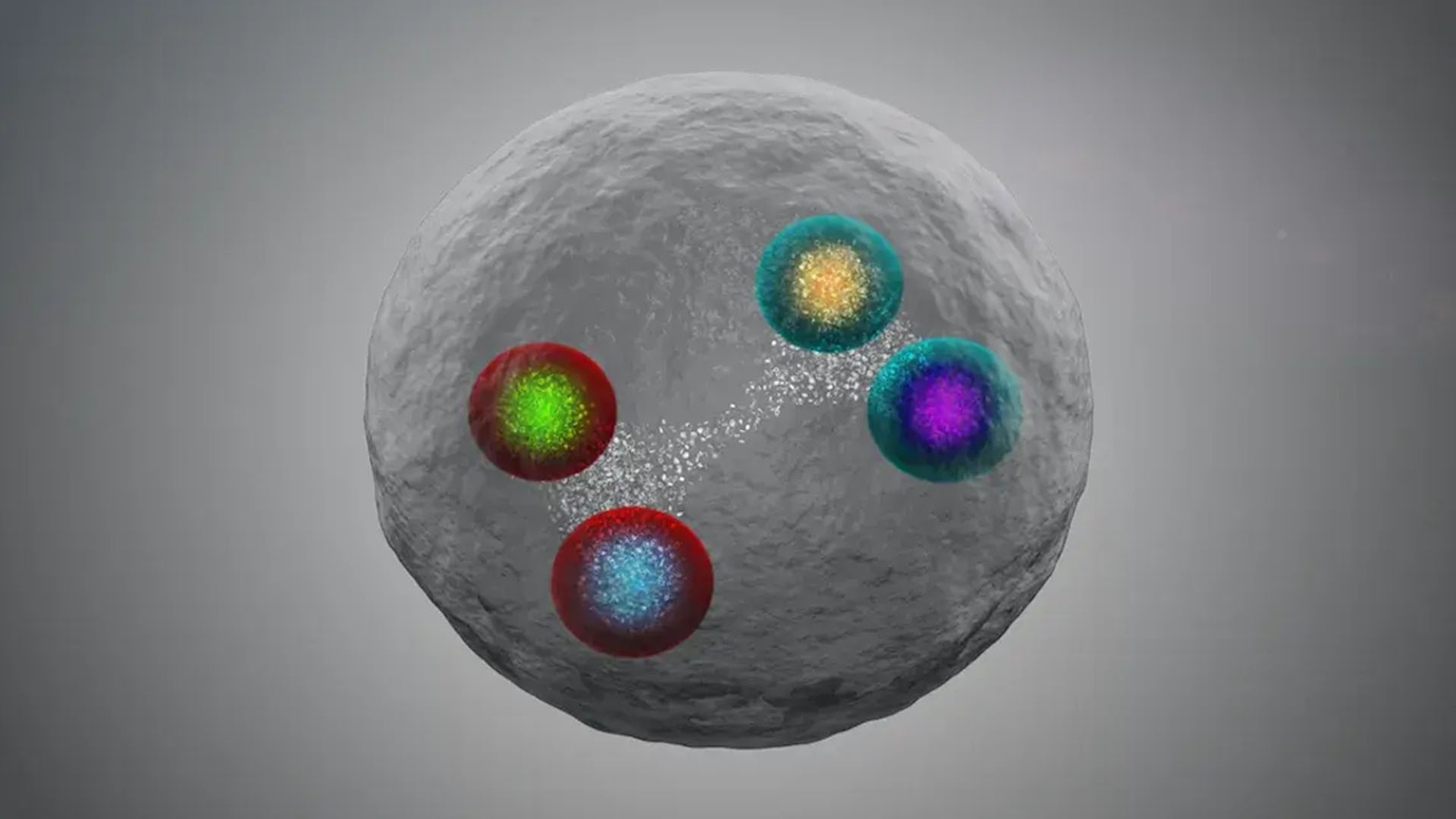
The strong interaction is one of the four fundamental forces of nature, alongside electromagnetism, gravity, and the weak interaction. Just as electrically charged particles exchange photons and attract or repel each other via electromagnetism, quarks—which carry a type of 'charge' called color—exchange gluons and interact according to the laws of the strong interaction. The strong coupling constant measures the strength of this interaction; it is a fundamental parameter of the Standard Model and is essential for interpreting experimental results at the LHC, where colliding protons are themselves composed of quarks bound together by this interaction.
This force behaves in an extraordinary way: unlike the others, its strength increases with distance. This property forces quarks to remain confined in color-neutral states—protons, neutrons, and other composite particles—making it impossible to observe them in isolation. This phenomenon, known as confinement, complicates not only the study of quark interactions but also the precise determination of the strong coupling constant, as it requires modeling how quarks are trapped inside composite particles.
Experiments such as ATLAS and CMS at the LHC can estimate the value of the constant, but their precision is limited by uncertainties in confinement models. Now, the study published in Nature has overcome this obstacle through numerical simulations of strong interactions, achieving unprecedented precision.
Supercomputing and new methods
The achievement combines massive supercomputing with theoretical techniques developed specifically for this calculation. This synergy between computational power and theoretical refinement has made it possible to determine the fundamental interaction between quarks with remarkable accuracy.
«Our research over the past years», says Alberto Ramos, «has focused on developing new methods specifically designed to solve this type of problem numerically. Only now, after employing enormous computational resources, have we been able to confirm that these methods far surpass conventional techniques».
The result, twice as precise as all experimental results combined, will enable LHC data to be analyzed with a new level of precision and will provide a stringent test of the Standard Model of particle physics.
The publication
Nature is considered one of the most prestigious scientific journals in the world. It rejects approximately 95% of submitted articles, and its impact factor is among the highest, alongside that of Science. Theoretical particle physics rarely appears in its pages, highlighting the importance of this result. However, this is not the first time IFIC has published in the journal: last year, it participated in the discovery of the most energetic neutrino ever observed—the so-called «neutrinazo»—a milestone that featured on the journal’s cover.
Alberto Ramos emphasizes that this publication represents «the culmination of many years of developing new analytical techniques, codes, and large-scale supercomputing projects. This publication confirms that the results obtained will have implications beyond our theoretical field and hold the potential to impact high-energy experimental physics».
Access the full paper: https://www.nature.com/articles/s41586-026-10339-4