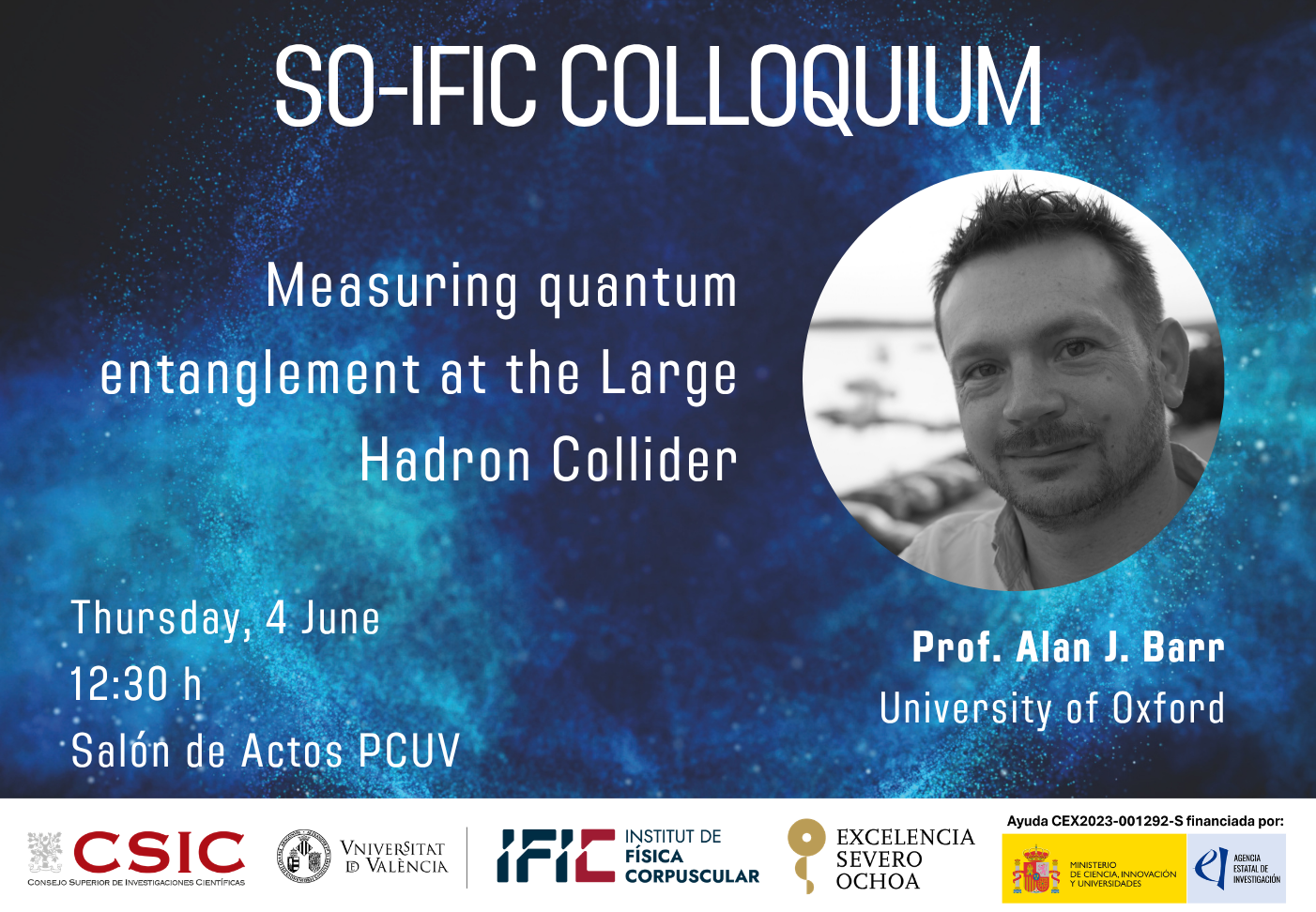





The new SO-IFIC Colloquium presents the measurement of quantum entanglement at the LHC.
“Measuring Quantum Entanglement at the Large Hadron Collider” is the title of the next SO-IFIC Colloquium, which will take place on June 4 at the Institute for Corpuscular Physics (IFIC), a joint center of the Spanish National Research Council (CSIC) and the University of Valencia.
Professor Alan J. Barr comes to IFIC with a colloquium in which he will describe how quantum entanglement can be studied in processes involving heavy particles at the Large Hadron Collider (LHC), with special attention to W and Z bosons and top quarks. Rather than measuring entanglement directly, particle physicists use observable decay patterns — such as angular correlations between leptons — to infer how the spins and quantum states of these particles are linked. Professor Barr will present the key ideas in an accessible way, highlight recent experimental strategies, and discuss how these measurements can test the Standard Model and potentially reveal new physics.
Alan J. Barr is Professor of Physics at the University of Oxford, where he leads the “Standard Model and Beyond” group. The group publishes extensively on quantum information in particle physics, supersymmetry, and searches for dark matter and dark sectors in ATLAS, as well as Standard Model measurements, the performance of real-time data selection (trigger) and offline reconstruction systems, citizen science and public outreach, LHC phenomenology, and physics prospects for future colliders and facilities.
Building on his previous leadership in dark matter searches at the LHC, Barr also contributes to the international effort to establish the “Forward Physics Facility,” a proposed installation for high-energy neutrino and dark matter physics studies at the LHC, where he co-leads the FASER-2 experiment.
He has also been involved in the ATLAS experiment at the Large Hadron Collider (LHC) since 1999, when the experiment was still in its research and development (R&D) phase. Other lines of his research include the search for signals of new particles, particularly Higgs bosons and dark matter particles; and the investigation of the foundations of quantum theory in high-energy colliders, using techniques from the field of quantum information theory to perform quantum state tomography, entanglement detection, and Bell tests of local realism.
With such an impressive résumé, the next SO-IFIC Colloquium promises to unveil the mysteries of quantum entanglement.
Colloquium link: here.