


Alfonso Andrés García Soto, researcher at IFIC, receives the Giorgos-Androulakis Award from the international KM3NeT collaboration
Alfonso Andrés García Soto, researcher at the Instituto de Física Corpuscular (IFIC), a joint center of the Spanish National Research Council (CSIC) and the University of Valencia, has been awarded the Giorgos-Androulakis Early-Career Scientists Prize, which recognizes his exceptional scientific impact within the international KM3NeT project.
The KM3NeT collaboration highlighted the following aspects: «Alfonso not only has a broad overview of neutrino physics within KM3NeT, but also in other experiments such as T2K and IceCube. Moreover, he is a leading figure in these activities. He has taken the initiative to improve high-energy neutrino simulations in GENIE, to develop BDTs for the selection of astronomical events, and to be one of the first developers of the Aanet framework for diffuse and point-like sources. He is co-organizer of the DM/Exotics group, and his colleagues particularly value him for mentoring master’s and PhD students».
The Giorgos-Androulakis Prize began to be awarded in 2023 and is granted annually in two categories: Early-Career Scientists and Technicians/Engineers. In this third edition, held during the KM3NeT collaboration meeting that recently took place in Valencia, the experiment sought to recognize García’s career and scientific contributions.
In the researcher’s own words, «it is an honor to have your work recognized». «What has made me happiest about this award is that my work in training students has also been valued», he adds.
The KM3NeT collaboration brings together around 300 researchers from more than 60 international institutions and is building a new generation of neutrino telescopes in the Mediterranean sea. These detectors, called ARCA and ORCA, will make it possible to study high-energy cosmic neutrinos and atmospheric neutrino oscillations. IFIC, and in particular the VEGA group (Valencia Experimental Group of Astroparticles), plays a prominent role in the experiment, contributing to hardware and software development as well as data analysis. García is enthusiastic about the future of the experiment: «Neutrino telescopes, and KM3NeT in particular, are entering a very exciting phase. The amount of physics that can be studied with these detectors is fascinating».
Alfonso García Soto holds a degree in Physics from the University of Granada and obtained his PhD at the Institut de Física d’Altes Energies (IFAE), where he was a member of the T2K collaboration. His postdoctoral career began at the Nikhef Institute (Netherlands), and later continued at Harvard (USA) thanks to a Marie Skłodowska-Curie Global Fellowship.
Since 2024, he has been a distinguished CDEIGENT researcher at IFIC as a member of the VEGA group and participates in the international collaborations KM3NeT and IceCube. His research has focused on the study of neutrino properties. He currently leads several projects, including a Red Leonardo project, related to the application of artificial intelligence to neutrino telescopes. He has also carried out multiple studies in the field of high-energy neutrino interactions, which led him to become part of the GENIE project and the NuSTEC collaboration.
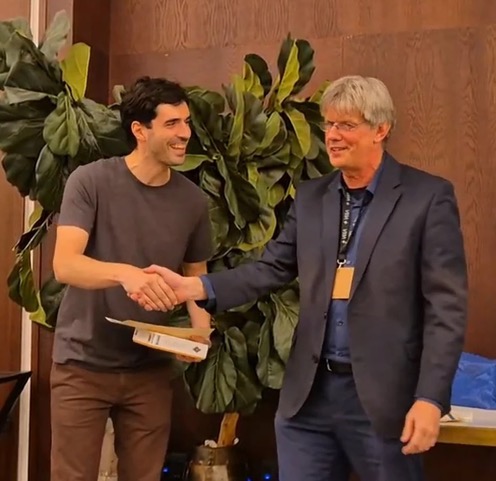
Photograph of the award ceremony: Alfonso García Soto (left) receives the award from the spokesperson of the KM3NeT collaboration, Paul de Jong (right).
Access to the news published on the collaboration’s website: see here.