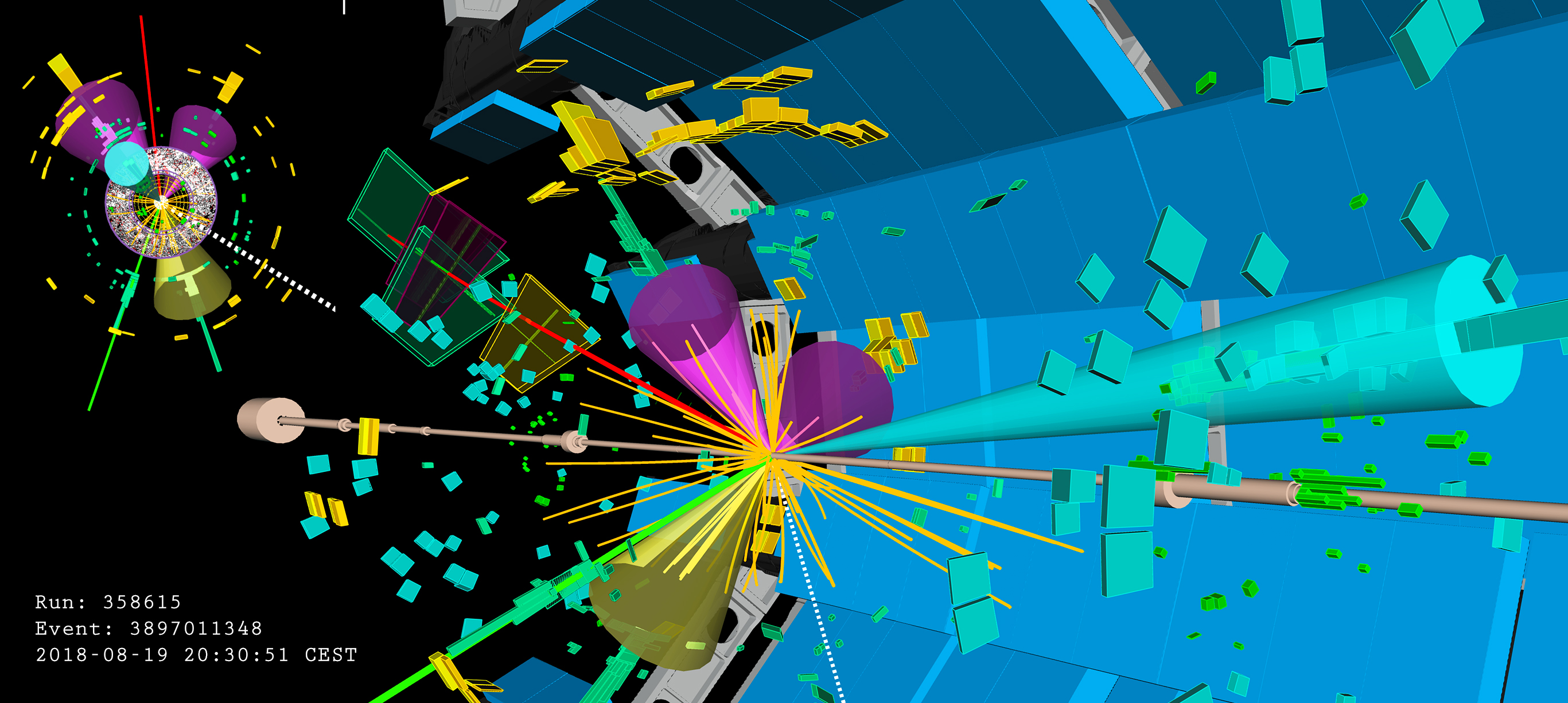





IFIC researchers explore the interaction between top quarks and Higgs bosons using multilepton events in the ATLAS experiment
A team from the Institute of Corpuscular Physics, IFIC, a joint center of the Spanish National Research Council (CSIC) and the University of València (UV), led by CSIC researcher Ximo Poveda and UV professor María Moreno Llácer, has played a key role in the new ATLAS collaboration result on the interaction between the Higgs boson and the top quark. The top quark is the most massive known elementary particle and, therefore, has the strongest interaction with the Higgs boson. This makes it especially important for understanding how the Higgs field generates the mass of fundamental particles.
A recent paper by the ATLAS Collaboration, accepted for publication by the Journal of High Energy Physics, studies the production of the Higgs boson together with a top-quark pair (known as “ttH production”). Although this process accounts for only about 1% of all Higgs boson production at the LHC, it provides a unique opportunity to directly measure the top–Higgs interaction.
ttH “multilepton” analysis
Using the full LHC Run-2 dataset (collected between 2015 and 2018), the ATLAS Collaboration has completed a new measurement of ttH production, focused on “multilepton” events, that is, those with several charged leptons (electrons, muons or taus) in the final state.
The data are divided into six exclusive categories based on the number and charge of the leptons. Categories that include one or two tau leptons decaying hadronically are especially sensitive to Higgs boson decays into tau pairs (H→tautau), while the remaining categories primarily target Higgs boson decays into W bosons (H→WW*). This analysis incorporates numerous improvements in the particle identification, reconstruction methods and multivariate analysis techniques.
Results
The results are presented in terms of the “signal strength”, defined as the observed ttH production rate divided by the predicted rate in the Standard Model. The measured ttH signal strength (μttH) is 0.63+0.20−0.19, slightly lower than the Standard Model expectation (1.0) but compatible within experimental uncertainties.
A complementary measurement of Higgs-boson production in association with a single top quark (tH) was also performed. In this case, the signal strength was measured as μtH = 7.2+4.6−4.0, slightly above the Standard Model expectation. A similarly high value has been reported in previous ATLAS and CMS results for this process.
In addition, measurements were performed as a function of the Higgs boson’s transverse momentum, providing sensitivity to different production mechanisms and potential effects beyond the Standard Model. The study also studied whether the interaction between the top quark and the Higgs boson could include charge–parity (CP) violating contributions.
IFIC’s contributions
Within a team of over 70 people, the IFIC researchers assumed full responsibility for the channel with three light leptons, the most sensitive channel in the analysis. Through the development of complex multivariate analysis methods, they achieved the sensitivity to extract the ttH signal from the background created by other processes. This analysis has also been the topic of the PhD theses of the IFIC students Lorenzo Varriale and David Muñoz.
References:
Paper: https://arxiv.org/abs/2510.23755 (accepted by JHEP)
Figures: https://atlas.web.cern.ch/Atlas/GROUPS/PHYSICS/PAPERS/HIGP-2024-08/
ATLAS Briefing: https://atlas.cern/Updates/Briefing/Run2-ttH-multileptons
Presentation at the Higgs 2025 conference by Ximo Poveda: https://indico.cern.ch/event/1532417/contributions/6739183/attachments/3163857/5675051/Higgs25_20251027.pdf