




José Benlliure, a CSIC researcher at IFIC, has contributed to a significant study published in 'Nature Communications'
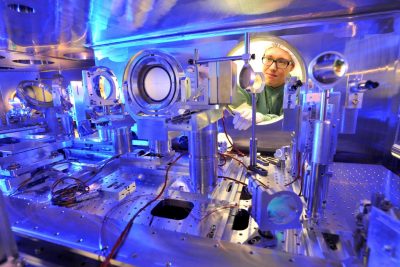
José Benlliure, a Research Professor at the CSIC and a member of the Instituto de Física Corpuscular (IFIC), a joint centre of the Spanish National Research Council and the University of València, has participated in a study recently published in the journal Nature Communications, which demonstrates for the first time that it is possible to independently identify neutrons produced by a laser accelerator. This work, led by researchers from the University of Seville, was carried out at the facilities of the Helmholtz-Zentrum Dresden-Rossendorf in Germany.
José Benlliure leads a research line at IFIC focused on the development of laser-based particle acceleration technology and its medical applications. The published result shows that laser accelerators can be used to generate neutron sources that are highly useful both for basic research and for applications of great social interest, such as neutron-induced radiotherapy or the production of radiotracers for medical imaging. This new laser-based neutron generation technology will help reduce costs and, therefore, democratise its use.
Neutron sources
Neutron sources are highly valuable scientific tools for both basic research and a wide range of technological and industrial applications. In fundamental science, they make it possible to study the structure and dynamics of matter at the atomic scale using techniques such as neutron scattering, which are particularly useful in solid-state physics, chemistry, biology, and materials science. Unlike other particles, neutrons have no electric charge, allowing them to penetrate deeply into materials and provide detailed information about atomic positions, vibrations, and magnetic properties.
In addition, neutron sources are essential for investigating fundamental phenomena in nuclear physics and in areas related to the strong interaction and the structure of the atomic nucleus. In research facilities, these sources can be generated using nuclear reactors or particle accelerators, providing neutron beams with controlled characteristics for high-precision experiments.
As for applications, neutrons are used in the non-destructive inspection of materials and industrial components, enabling the detection of internal defects without causing damage. They also play an important role in medicine; for example, in boron neutron capture therapy (BNCT), a promising technique for treating certain types of cancer. They are also used in the analysis of archaeological materials, in nuclear security, and in the development of new advanced materials, such as resistant alloys or superconductors.
Overall, neutron sources represent a strategic scientific infrastructure, as they combine the ability to expand fundamental knowledge of matter with a direct impact on technological innovation and social well-being.
Laser-generated neutrons
Laser-generated neutron sources represent an emerging technology in the field of nuclear physics and compact accelerators. In these systems, very high-intensity laser pulses interact with a solid or gaseous target, producing charged particles (such as protons or deuterons) that, upon colliding with another material, generate neutrons through nuclear reactions. This approach is based on recent advances in ultra-high-power lasers and plasma-based particle acceleration techniques.
As José Benlliure explains, «one of the main advantages of laser-generated neutron sources is their compactness compared to traditional sources based on nuclear reactors or large accelerators, which opens up the possibility of having smaller and potentially less costly facilities». He also notes that «they make it possible to generate extremely short neutron pulses, on the order of nanoseconds or even less, which is particularly useful for studying ultrafast dynamic processes in materials».
Another important advantage is their flexibility and operational safety, since they do not require maintaining a nuclear chain reaction and can be activated only when the laser is fired. Finally, these sources have great potential for future applications in high-resolution radiography, materials science, non-destructive testing, and, in the field of basic research, in the study of nuclear reactions and fundamental properties of matter.
References:
M. A. Millán-Callado, S. Scheuren, A. Alejo, J. Benlliure, R. Beyer, T. E. Cowan, B. Fernández, E. Griesmayer, A. R. Junghans, J. Kohl, F. Kroll, J. Metzkes-Ng, I. Prencipe, J. M. Quesada, M. Rehwald, C. Rödel, T. Rodríguez-González, U. Schramm, M. Roth, R. Štefaníková, S. Urlass, C. Weiss, K. Zeil, T. Ziegler & C. Guerrero
"Single-event fast neutron time-of-flight spectrometry with a petawatt-laser-driven neutron source".
Nature Communications 17, 3154 (2026)