



The 4th COMCHA School is successfully held
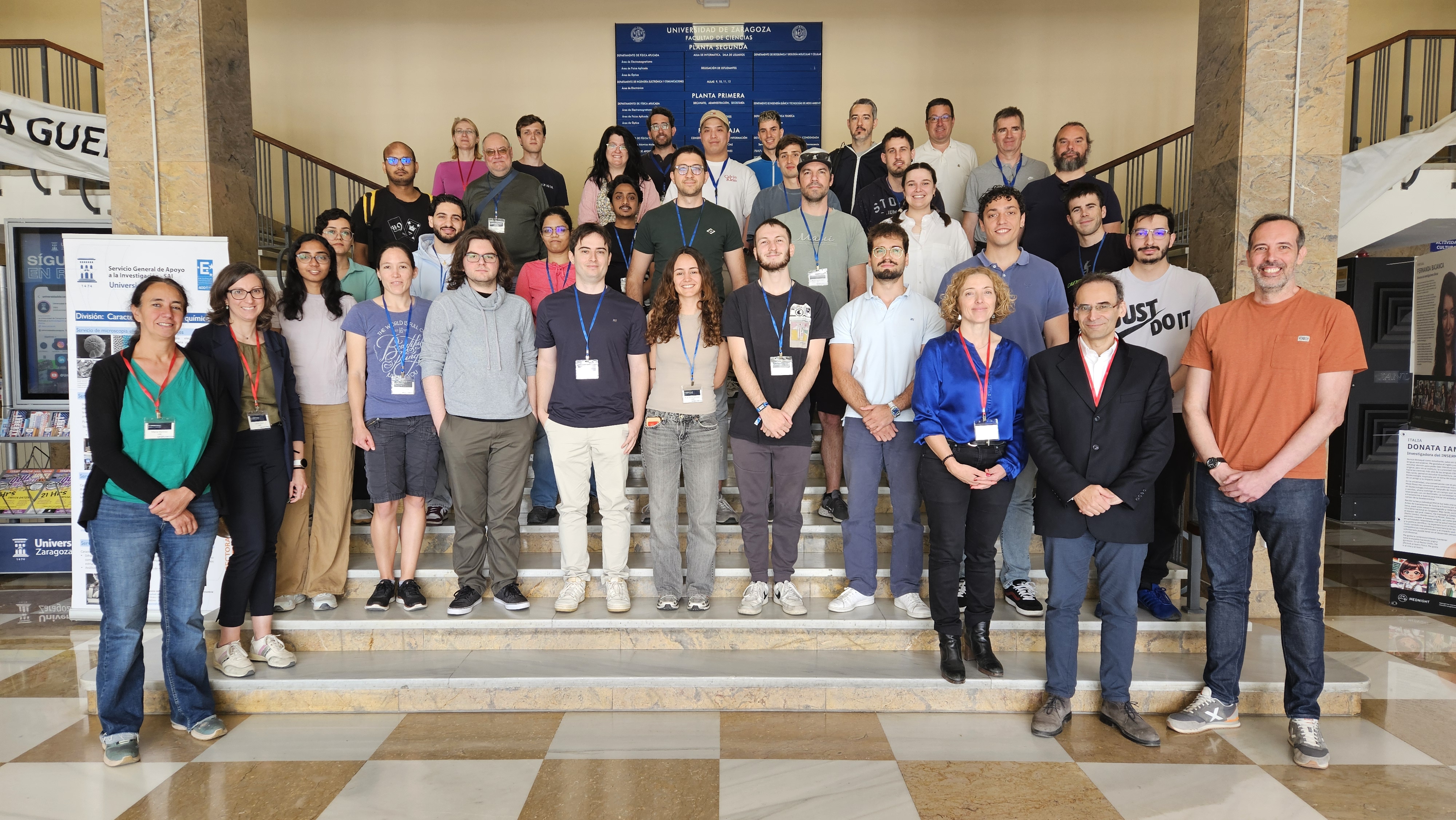
The 4th COMCHA School (Computing Challenges), coordinated among others by members of IFIC—a joint center of the Spanish National Research Council (CSIC) and the University of Valencia (UV)—was held in Zaragoza from April 8 to 15.
IFIC researchers Arantza Oyanguren and Luca Fiorini are coordinators of the COMCHA network, while researchers José Enrique García and José Salt are part of the executive committee. The school also received support from researchers at the CAPA Institute (Center for Astroparticles and High Energy Physics) of the University of Zaragoza, who hosted the event.
The COMCHA network was created in 2017 as a spontaneous initiative of several Spanish groups involved in the High-Luminosity LHC upgrade, with the aim of addressing common challenges in signal reconstruction, artificial intelligence, Big Data, tracking, and the development of machine learning algorithms on CPUs, GPUs, and FPGAs.
Originally conceived as a discussion forum, since 2019 the school has become a cutting-edge training initiative in computing technologies. In addition to Machine Learning, it featured hands-on sessions on large language models, quantum computing, and programming for heterogeneous computing architectures such as FPGAs and GPUs, as well as simulations.
“This school covers technologies that span a wide range of scientific disciplines while also exposing students to real-world applications,” says David Lange (Princeton University), a program lecturer and a recognized leader in scientific software for High Energy Physics and principal investigator of initiatives funded by the NSF (National Science Foundation).
The event brought together more than 50 participants from a wide variety of institutions and backgrounds, with particularly notable and highly appreciated contributions from both Spanish and international speakers. The school fostered a dynamic and interactive environment between instructors and students.
Over the course of the week, 28 attendees took part in a lecture program covering both fundamental concepts and recent advances in computing for High Energy Physics and related fields. The program included more than 45 hours of training; students learned how to perform optimized programming and about the important differences between offline computing and real-time computing.
In addition to the coordinators and executive committee, several IFIC members delivered lectures, including Miriam Lucio, Emma Torró, Jiahui Zhuo, Bryan Zaldívar, and José Enrique García.
“The school has been a real success thanks to the excellence of the researchers in the network working with advanced computing techniques, and their personal commitment to sharing knowledge and training young researchers,” says Arantza Oyanguren, coordinator of the network together with Luca Fiorini.
Thus, once again, the COMCHA School concludes with great success in participation and with new perspectives in the learning of computing technologies.
References:
www.comcha.es