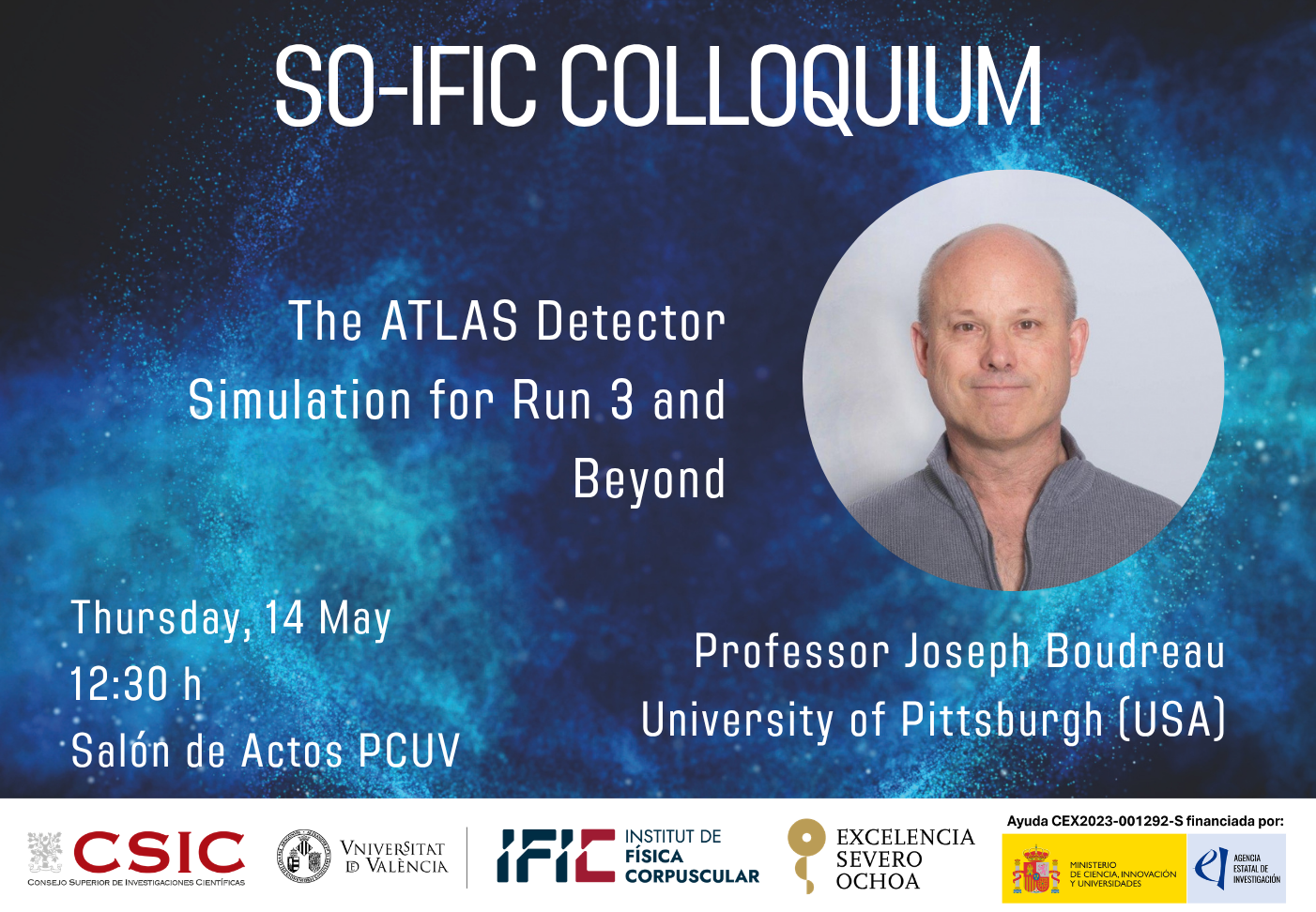




The new SO-IFIC Colloquium discusses the simulation of the ATLAS Experiment detector for Run 3.
Next Thursday, May 14th, the IFIC, a joint center of the Spanish National Research Council (CSIC) and the University of Valencia (UV), will welcome Professor Joseph Boudreau from the University of Pittsburgh to deliver the SO-IFIC Colloquium “ATLAS Detector Simulation for Run 3 and Beyond.”
The detector simulation of the ATLAS Experiment is a critical component of the computing infrastructure for the particle physics community and represents a major capital investment by funding agencies. It has been widely used throughout all phases of the detector’s lifetime, from conceptual design to the publication of results, as well as during its upgrades.
This colloquium will provide an overview of the structure of Monte Carlo simulation within the ATLAS experiment, including the precise description of geometry and materials, as well as the modeling of physical processes using the Geant4 toolkit. Major upgrades are currently underway in the CERN accelerator complex to increase the data acquisition rate by a factor of 7 to 10, placing enormous pressure on computing resources.
The emergence of artificial intelligence, particularly generative AI, is becoming a complement to particle transport paradigms that have remained largely unchanged for decades. The talk will discuss how these techniques are being integrated into the simulation infrastructure in preparation for the high-luminosity era.
Joseph Boudreau is a professor in the Department of Physics and Astronomy at the University of Pittsburgh in Pennsylvania, USA. His work combines physics, computing, programming, and the design of advanced tools, making major contributions to the development of software used by the high-energy physics community. Throughout his career, Professor Boudreau has participated in experiments such as CDF at the Tevatron proton–antiproton collider, ALEPH at the LEP electron–positron collider, and ATLAS Experiment at the LHC proton collider, always maintaining a strong connection between fundamental physics and technological innovation.
He has worked on high-precision measurements of the properties of elementary particles, including the Z boson, b-flavored hadrons, and the top quark, the most massive known particle. In fact, he has devoted more than two decades to top quark physics, developing formalisms and detailed studies of its properties, including polarization measurements and helicity fractions, as well as studies that have established some of the most stringent limits on Wilson coefficients sensitive to single top quark production processes.
Beyond his physics results, Boudreau is also recognized for his pioneering role in the description, simulation, and visualization of events in high-energy physics. He is the lead author of the ATLAS Virtual Point 1 program, the well-known three-dimensional visualization tool that allows intuitive and detailed exploration of both the ATLAS detector and the collisions it records. The program has become a key tool for data taking in the experiment’s control room, as well as for analysis and science outreach.
Furthermore, Professor Joseph Boudreau is currently serving as a Distinguished Severo Ochoa Visitor at the IFIC from May 11th through August 7th, 2026.