



The IFIC leads technology transfer in medical and nuclear physics with three projects awarded by the IMPULSA-T program of the CSIC
The Instituto de Física Corpuscular (IFIC), a joint center of the Spanish National Research Council (CSIC) and the Universitat de València (UV), has achieved remarkable success in the 2025 call of the IMPULSA-T program, part of the CSIC’s CONVERGE strategy. CONVERGE is an open innovation hub created by the CSIC to promote the effective transfer of knowledge to society and to build new relationships of trust between the CSIC and different innovation stakeholders.
In this context, out of all the projects submitted nationwide, 10 awards were granted for the creation of spin-offs, three of which were developed by the IFIC, consolidating the Institute as a benchmark in the development of proposals for technology-based companies.
A strategic boost for innovation
The IMPULSA-T program is designed to accelerate the market entry of disruptive technologies. It supports innovative projects with market potential at more advanced stages (TRL3+) and guides them through the different processes involved in establishing a knowledge-based company. Each project will receive €40,000 to mature its business plan and increase its technological readiness level (TRL) toward the creation of a new company.
The first of the three awarded projects is GNVision (Detection and classification of nuclear waste). Led by Víctor Babiano Suárez and Jorge Lerendegui Marco, the project is developing a portable dual-radiation detector (gamma and neutron) with AI-assisted high-resolution imaging capabilities. GNVision addresses the bottleneck in nuclear waste classification by reducing operators’ radiation exposure by a factor of 10 and enabling the in situ identification of actinides, a task that currently requires weeks of laboratory analysis.
According to Babiano, “With GNVision, we bring efficiency and safety to the nuclear industry through high-resolution imaging for locating gamma and neutron radioactive sources. It is a pioneering solution whose remote detection capability can be directly transferred to other scenarios such as defense and security.”
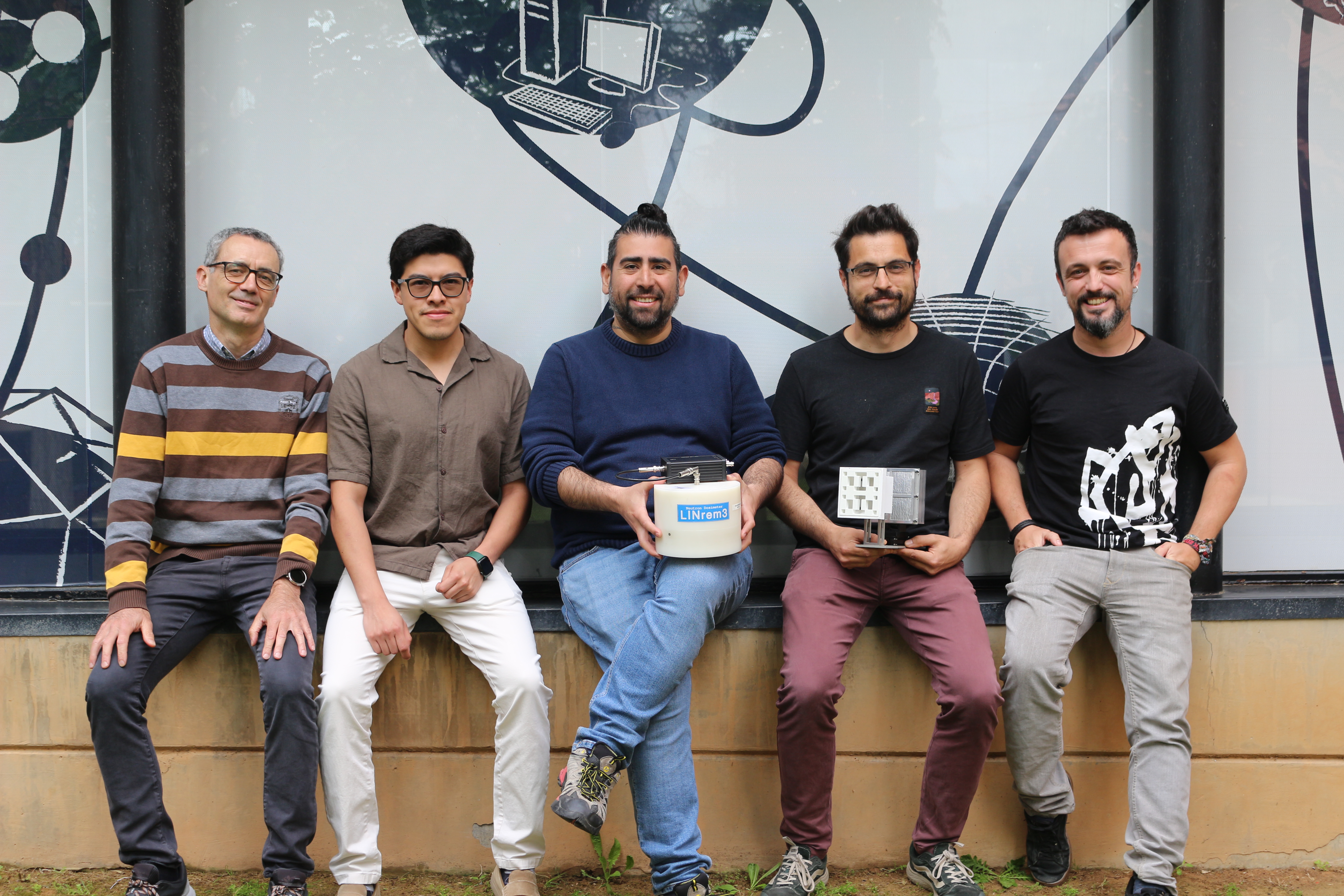
Another awarded project is LINrem (Next-generation neutron dosimetry). Under the leadership of Ariel Tarifeño-Saldivia, the team is developing neutron dosimeters that overcome critical limitations of current commercial systems: precision dosimetry with sub-millisecond temporal resolution, linear response in pulsed fields, and improved portability. The technology, validated at several international facilities, enables real-time monitoring for radiation protection in proton therapy, the nuclear industry, defense, and commercial aviation.
The project aims to prepare for the possible creation of a company in 2027 and explore the transition toward applications with direct clinical impact. “This grant is a decisive step,” says Tarifeño. “After years of development, we can now prepare the leap to the market with a family of neutron dosimetry technologies adapted to critical needs in sectors such as healthcare, defense, and aviation.”
Finally, NeuThera / Monitor BNCT (Compton imaging for cancer therapy), led by Pablo Torres Sánchez, proposes a dose-monitoring system based on 3D Compton imaging (patented technology) for Boron Neutron Capture Therapy (BNCT). As there are currently no commercial competitors, this system is key to ensuring the safety and effectiveness of this advanced radiotherapy by allowing clinicians to see, in real time, how much dose the tumor is actually receiving.
“Our monitor represents a unique strategic positioning opportunity,” says Torres. “We solve the lack of in vivo dosimetry, one of the greatest barriers to the worldwide clinical adoption of BNCT therapy.”
Through these achievements, the IFIC further strengthens its firm commitment to transferring scientific excellence to society.