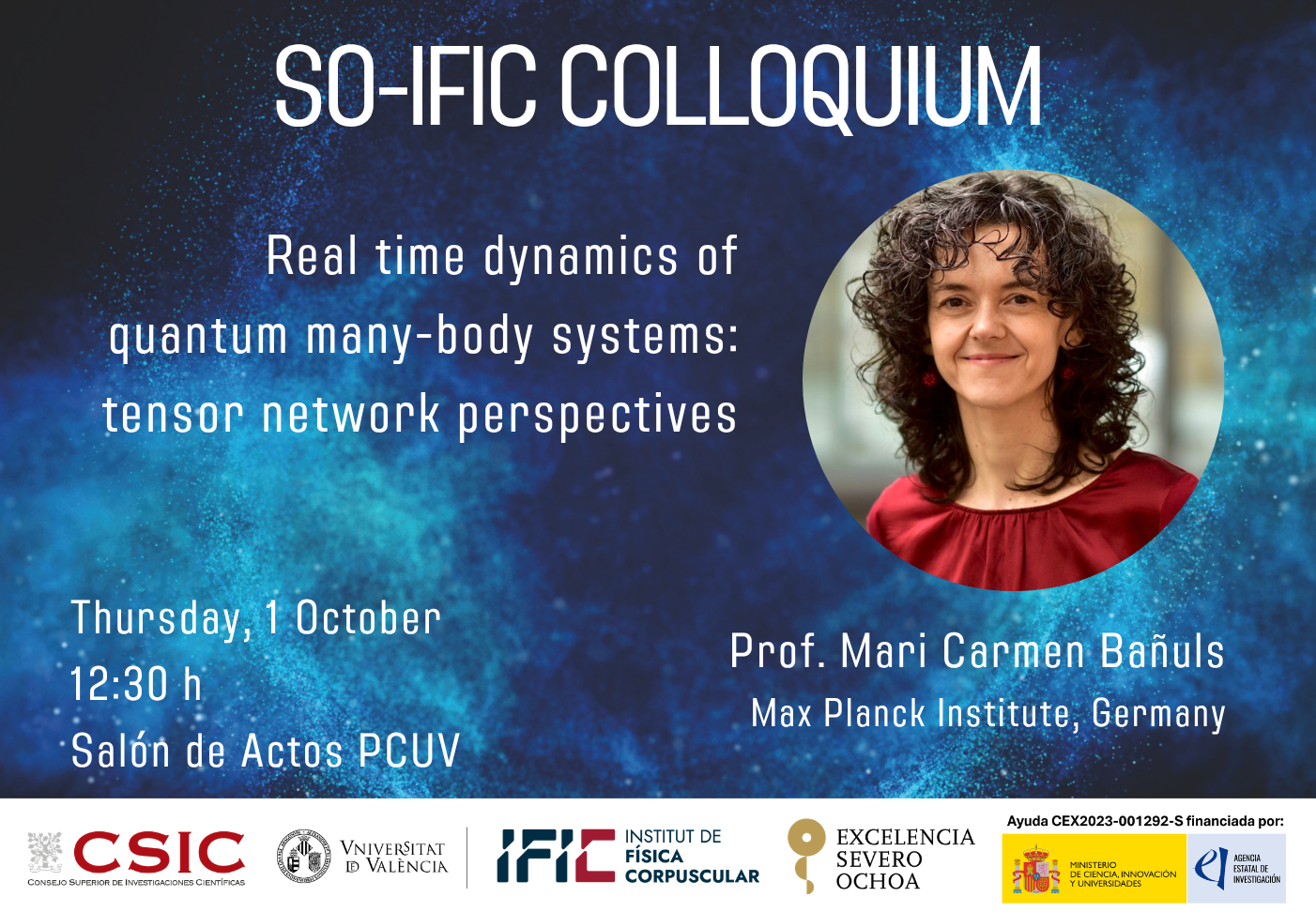





SO-IFIC Colloquia return to explore the real-time dynamics of quantum many-body systems
After the summer break, the SO-IFIC Colloquia are back, this time featuring Professor Mari Carmen Bañuls, who holds a PhD in Physics from the University of Valencia and a PhD in Computer Science from the Universitat Politècnica de València.
Under the title “Real-time dynamics of quantum many-body systems: tensor network perspectives,” on October 1, Professor Bañuls will present how simulating the dynamics of quantum many-body systems represents one of the major challenges in quantum physics, with implications ranging from the study of thermalization to quantum information processing. Tensor networks are among the most promising methods for studying out-of-equilibrium quantum many-body systems, at least in low spatial dimensions.
However, the growth of entanglement considerably limits the applicability of standard algorithms to this problem. Recently developed methods seek to overcome this limitation by focusing on local properties.
In this talk, Professor Bañuls will present a recent example, known as “transverse folding,” in which time-dependent local observables are represented by a space-time tensor network. This dual space-time representation gives rise to so-called “temporal vectors” and temporal entropies, which are essential for determining the efficiency of the approach and also encode a rich structure of correlations.
Mari Carmen Bañuls is a physicist and computer scientist, born in Valencia in 1973, and is currently the leader of the Tensor Networks and Quantum Many-Body Systems research group at the Max Planck Institute for Quantum Optics. Her research focuses on the development and application of tensor network methods for the numerical simulation of quantum many-body systems. An important part of her work addresses the dynamics of out-of-equilibrium systems and the development of new tools for their study.
She is the author of numerous papers published in leading international journals in quantum physics and condensed matter physics. Among her distinctions is the Spanish Order of Civil Merit, awarded in 2015.
Since 2019, she has been involved in coordinating research initiatives in quantum simulation and serves on editorial boards and scientific juries, including the jury for the Jaume I Awards.