




IFIC consolidates its integration into the international scientific network LHCONE
The Institute of Corpuscular Physics (IFIC, a joint centre of the Spanish National Research Council, CSIC, and the Universitat de València) has consolidated its integration into the international scientific network LHCONE, the advanced connectivity infrastructure of CERN designed to support the massive data flow generated by the Large Hadron Collider (LHC). This strategic advancement strengthens the centre’s capacity to participate in the processing and distributed analysis of data from major international particle physics experiments such as ATLAS and LHCb.
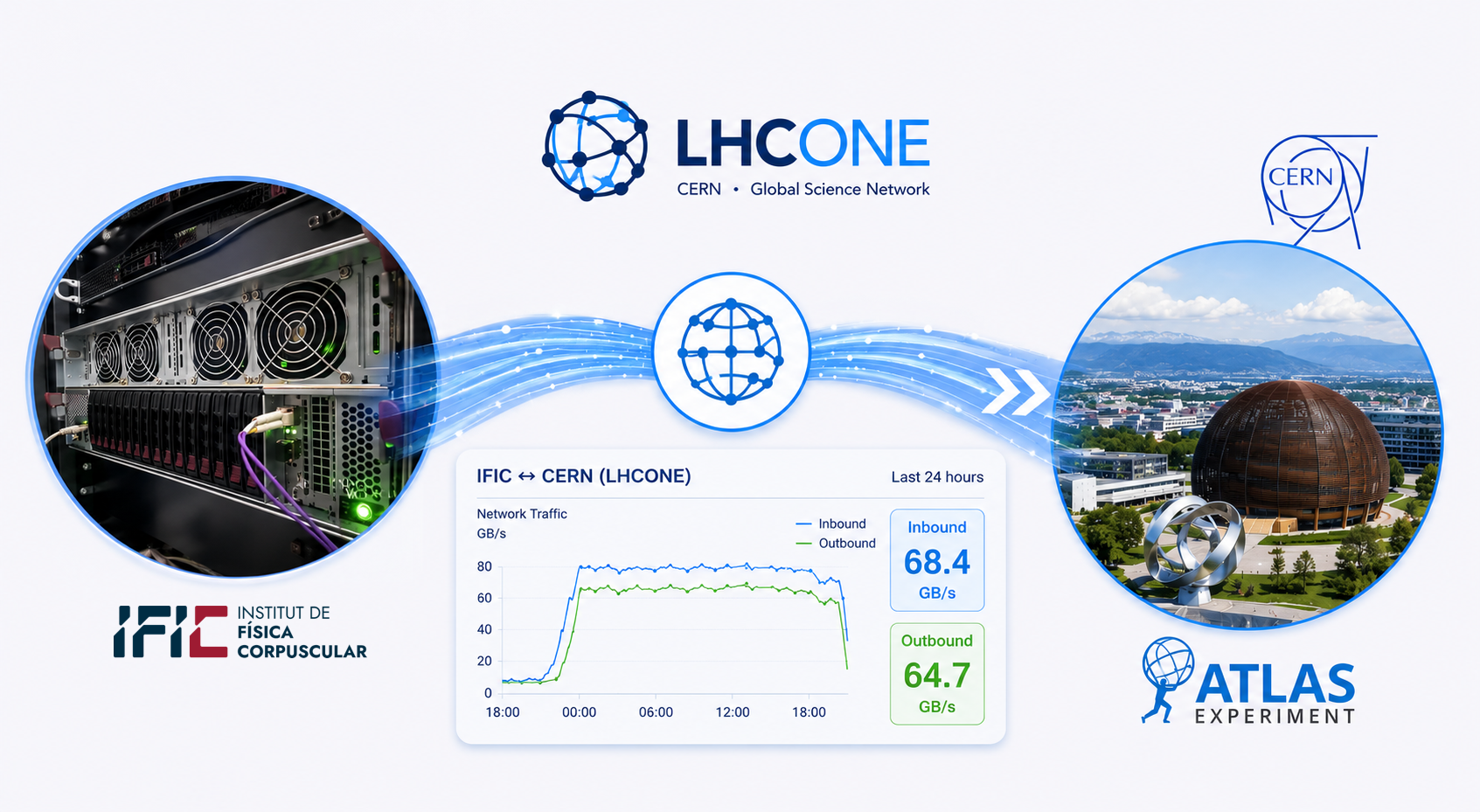
Integration into LHCONE is already allowing IFIC to achieve record data transfer rates, as reflected in the latest network traffic statistics, which show historic peaks of several tens of GB/s sustained through the dedicated connection. These values place IFIC among the centres with the highest activity and data exchange capacity within the LHC distributed infrastructure.
Within the first 24 hours connected to the CERN LHCONE network (as can be seen in the figure), thanks to the magnificent work of the IT service of the Universitat de València, particularly José Miguel Femenia Herrero, the IT service of IFIC, specifically Francisco Javier Sánchez Martínez, and the IFIC ATLAS Tier-2 project, whose principal investigator is Santiago González de la Hoz.
As can be seen in the traffic statistics, data input and output flows of between 60 and 70 GB/s are already being reached. Impressive. Spectacular. This represents a true leap in both quality and scale for our Universitat and for IFIC.
«This connection allows us to receive and send much more efficiently the enormous amounts of data generated by CERN’s LHC collider, especially from the ATLAS experiment, thereby reinforcing IFIC’s role within the global distributed computing infrastructure of the LHC», notes Santiago González.
LHCONE is a global private network specifically optimised for scientific traffic, avoiding the limitations and congestion of the conventional internet and ensuring high-capacity, stable, and low-latency connections between research centres worldwide. Thanks to this infrastructure, IFIC can access and transfer more efficiently the vast volumes of information produced by the LHC, which are essential for research on the Higgs boson, the top quark, and the search for new physics.
In addition, this integration strengthens IFIC’s role within the Worldwide LHC Computing Grid (WLCG), the global distributed computing infrastructure that makes CERN data analysis possible. The improved connectivity will optimise both production and simulation processes, as well as remote access to large-scale scientific datasets.
The connection to LHCONE has been carried out in coordination with RedIRIS, the Universitat de València, and the international technical teams of the collaboration, implementing advanced mechanisms for security, traffic segregation, and optimisation of data transfer routes.
With this new technological milestone, IFIC continues to strengthen its position as one of the leading European centres in scientific computing and data analysis for high-energy physics, while also preparing for the future computational challenges of the High-Luminosity LHC (HL-LHC), which will multiply data volumes and processing requirements over the next decade.