


IFIC holds a new edition of the International Masterclasses in particle physics.
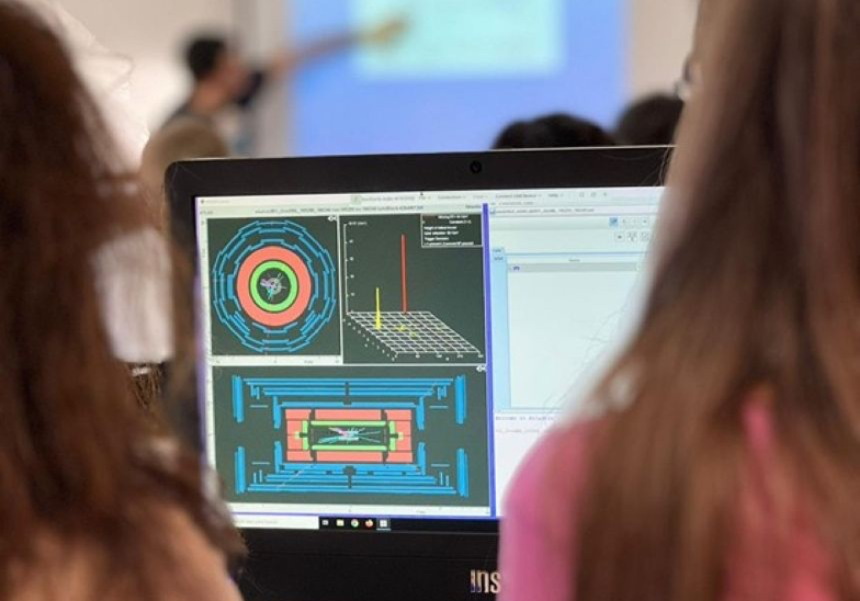
One more year, the Institute of Corpuscular Physics (IFIC), a joint center of the Universitat de València and the CSIC, together with the Faculty of Physics of the University of Valencia, has offered its cycle of International Masterclasses for secondary and high school students (“Hands on Particle Physics”), organized by the International Particle Physics Outreach Group (IPPOG). This year, around 300 students from 70 schools across the Valencian Community participated, with the collaboration of more than 50 IFIC members. The aim of these sessions is for students to spend a day at our research center, carry out a hands-on analysis of data taken from real particle physics experiments, experience what it is like to be physicists for a day, and gain in-depth insight into the work of several of the center’s research groups.
The first and largest session took place on February 11th, coinciding with the celebration of the International Day of Women and Girls in Science. This session was aimed at encouraging scientific vocations among female students, with more than 70 girls from the 3rd and 4th years of compulsory secondary education participating. It was dedicated to the ATLAS experiment at CERN. During the exercise, students studied the Z boson and the Higgs boson, and also had the opportunity to learn firsthand about the work of IFIC researchers.
The second masterclass was one of this year’s new additions. Dedicated to nuclear physics, it took place on February 17th, and students were able to take part in different games and exercises.
The third session was held on February 20th, where students analyzed data from the LHCb experiment. In this masterclass, they measured the properties of the D0 meson, a “charmed” particle—that is, one containing a charm quark (c).
On March 12th, the masterclass dedicated to the ATLAS experiment took place, where students used real data to deduce the internal structure of the proton and searched for signals of the W boson, one of the particles that mediates weak interactions.
As a second new feature, on March 23rd the first edition of the masterclass dedicated to the KM3NeT experiment was held, focusing on the neutrino detector located on the seabed of the Mediterranean Sea.
Finally, the sixth and last session took place on March 26th and was dedicated to the MINERvA experiment at Fermilab, which studies how neutrinos collide with atomic nuclei. In this masterclass, students were able to observe how neutrinos transform into muons when they interact with nuclei.
Throughout these sessions, students become physicists for a day, taking part in activities that combine introductory talks on particle physics, accelerators, and detectors with hands-on sessions analyzing real data obtained from major international scientific facilities. The program also includes a discussion of results and a videoconference with students from different countries participating simultaneously, allowing them to share conclusions in an international and collaborative environment. The initiative is part of a global program involving institutions from 60 countries and more than 13,000 participants worldwide. Its aim is to foster scientific vocations and bring cutting-edge research closer to pre-university students.
With this initiative, IFIC and the Faculty of Physics reinforce their commitment to scientific outreach and the promotion of STEM careers, offering students direct experience with modern science and its leading figures.