



The upcoming ASFAE–IFIC colloquium will reveal the key aspects of the new ATLAS Inner Tracker of the LHC
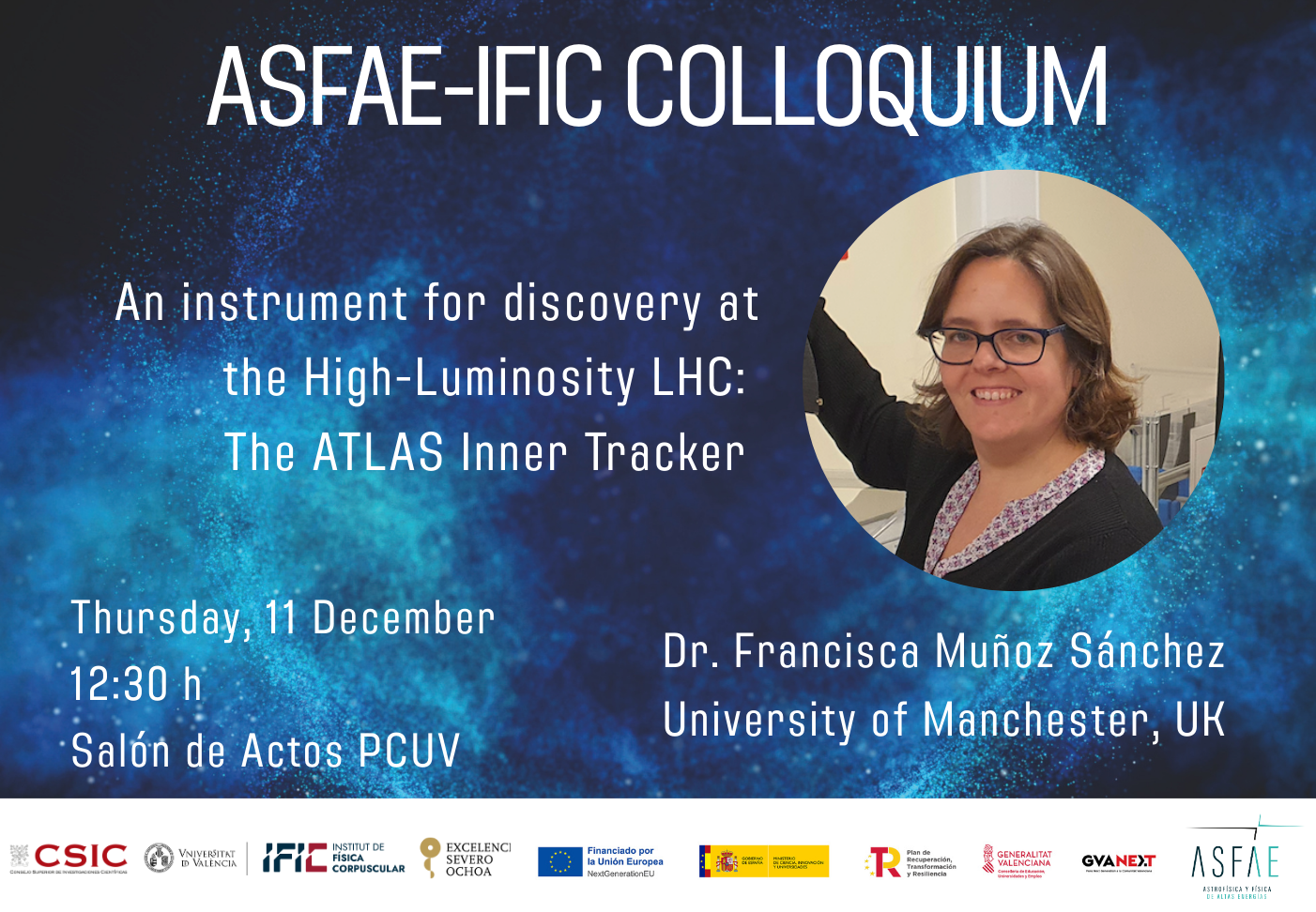
On Thursday, December 11, the IFIC is hosting an ASFAE–IFIC colloquium that will discuss the new tracking detector of the ATLAS experiment at CERN, the ATLAS Inner Tracker.
With the discovery of the Higgs boson in 2012, the Standard Model of particle physics has reached a remarkable degree of completeness. However, it still leaves several fundamental questions unanswered. For this reason, the particle physics community is searching for small deviations from Standard Model predictions or rare phenomena that could point the way toward new physics. Achieving this objective requires next-generation colliders that push the boundaries of both energy and statistical precision.
The Large Hadron Collider (LHC) is entering a new era with its upgrade to the High-Luminosity LHC (HL-LHC). To fully exploit the potential of this improved accelerator, the experiments themselves must also undergo major upgrades. In the ATLAS experiment, the innermost detector will be replaced by the new Inner Tracker (ITk), a fully silicon-based system designed to extend hermeticity and enhance spatial and temporal resolution while operating in an extremely harsh radiation environment. The detectors require support structures that position them with very high precision, must operate at low temperatures, and rely on electronics that provide both power and control signals to extract the data at very high speeds so that it can be analysed. All these systems can influence the detector’s performance in different ways and must be considered from the earliest development stages to avoid issues in the more critical phases closer to the detector’s delivery.
This talk will present the main achievements and lessons learned throughout the research, development, and production phases of the ITk, which is set to become the most advanced tracking detector ever built.
Dra. Francisca Muñoz Sánchez is a researcher at the University of Manchester and a member of the Particle Physics group. She completed her PhD at the University of Cantabria on R&D of silicon detectors for future colliders, titled Study of New Silicon Sensors for Experiments at Future Particle Colliders, and has also worked with diamond detectors, not only for collider applications but also for medical uses. Over the past 10 years, she has taken part in the R&D and construction of the mechanical supports for the new pixel detector of the Inner Tracker for ATLAS.
This colloquium has received funding from the Ministry of Science, Innovation and Universities through the NextGenerationEU funds (PRTR-C17.I01), as well as from the Generalitat Valenciana (GVANEXT). Project: ASFAE COORD.