



Serge Haroche, Nobel Laureate in Physics, shares experiences at the Institute of Corpuscular Physics (IFIC) and the UV Faculty of Physics
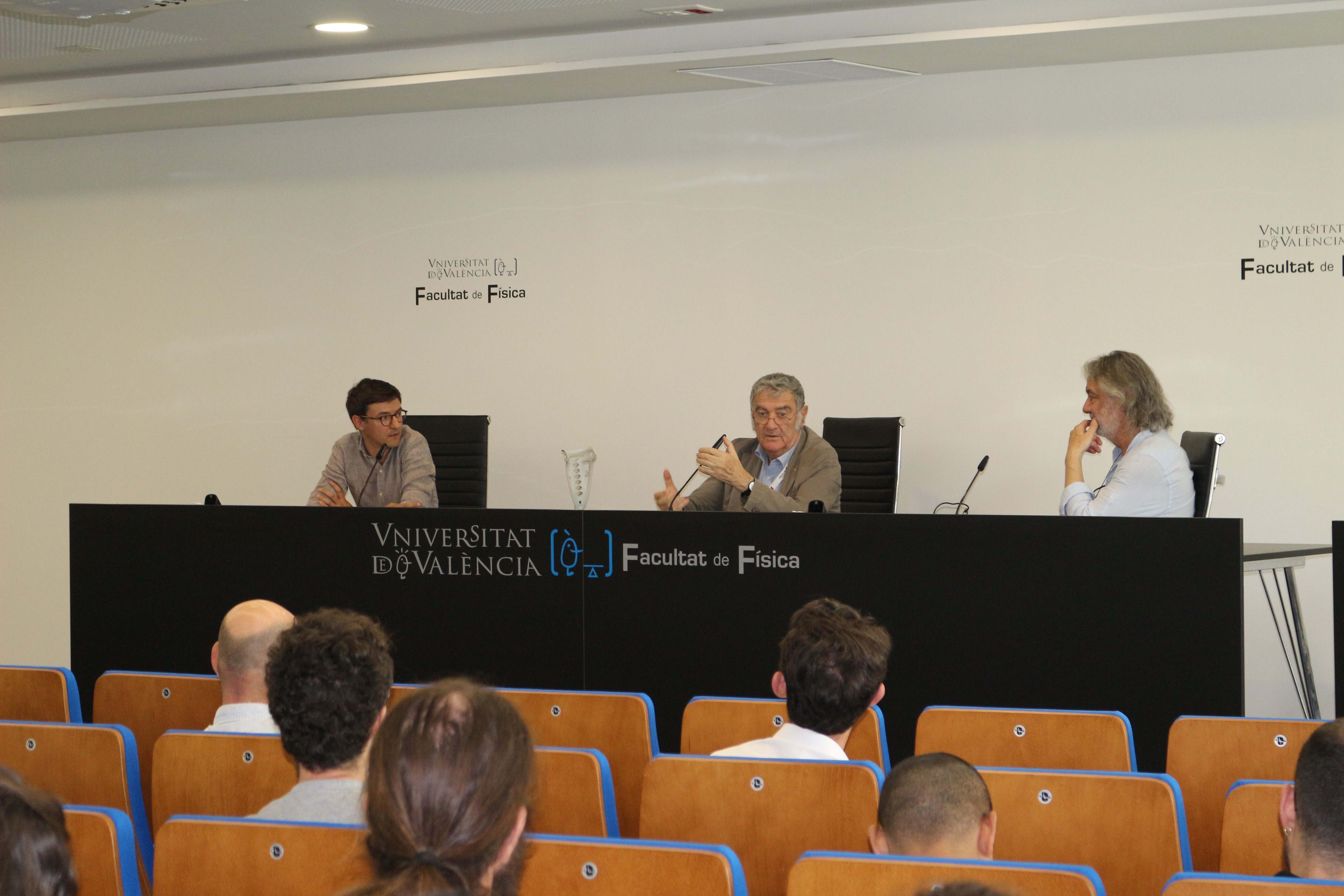
The Institute of Corpuscular Physics (IFIC)—a joint center of the Spanish National Research Council (CSIC) and the University of Valencia (UV)—and the UV Faculty of Physics had the honor of welcoming a leading figure in contemporary physics: Serge Haroche, winner of the 2012 Nobel Prize in Physics.
His visit to Valencia, on the occasion of his participation as a jury member for the Rei Jaume I Awards, provided the perfect opportunity to organize a very special event aimed particularly at the institution's youngest research staff: PhD students, postdoctoral researchers, and Ramón y Cajal and Gen-T grant holders.
The main activity featured a round table discussion titled “What you’ve always wanted to ask a Nobel Prize winner but never could,” which offered a unique opportunity to engage in a close and enriching dialogue with the laureate. In an informal and participatory format, attendees were able to share their thoughts and questions regarding scientific careers, current challenges in fundamental physics, key decisions in professional life, and many other topics. This was undoubtedly an inspiring encounter for the next generation of scientists.
About the guest Nobel laureate
Serge Haroche (Casablanca, French Protectorate of Morocco, September 11, 1944) has been a professor of quantum physics at the Collège de France since 2001. He has been a researcher at various institutions such as the Centre national de la recherche scientifique (CNRS) (1967-1975), Stanford University (1972-1973), or the École normale supérieure (1994-2000), where he became the head of the physics department.
Among Haroche's main achievements in the field of Cavity Quantum Electrodynamics are the observation of the enhancement of spontaneous emission of a single atom in a cavity, the direct monitoring of the decoherence of mesoscopic superpositions of states—the so-called Schrödinger's cat states—and the quantum non-demolition measurement of photons. By manipulating atoms and photons in high-Q factor cavities, he has also demonstrated elementary steps of quantum information protocols, such as the generation of atom-atom and atom-photon entanglement and the operation of quantum logic gates involving photons and atoms as "quantum bits."
He was awarded the Nobel Prize in Physics, jointly with David J. Wineland, for his work on the measurement and manipulation of individual quantum systems.