



IFIC reinforces its role in the new Governing Board of the Theoretical and Particle Physics Division of the Spanish Royal Society of Physics
The Instituto de Física Corpuscular (IFIC), a joint research center of the Spanish National Research Council (CSIC) and the University of Valencia (UV), is playing a significant role in the renewal of the Governing Board of the Theoretical and Particle Physics Division (DFTP) of the Spanish Royal Society of Physics (RSEF).
The RSEF is a non-profit institution founded in 1903 with the aim of promoting the development of physics, both in terms of fundamental knowledge and its applications, as well as fostering scientific research and education at all academic levels. It has also been recognized as a Public Utility Association. The Spanish Royal Society of Physics is organized into four divisions, one of which is the Theoretical and Particle Physics Division (DFTP), the main forum for coordination and representation of the Spanish community working in particle physics, theoretical physics, and related disciplines. Its objectives include promoting research, disseminating scientific knowledge, encouraging collaboration among research groups, and organizing scientific meetings, schools, and activities aimed at new generations of researchers.
The work of the DFTP Governing Board is particularly important at a time of intense activity in particle physics, marked by preparations for future international scientific infrastructures and the development of new research initiatives.
The recent renewal of the DFTP Governing Board represents significant recognition of IFIC’s role within the Spanish particle physics and theoretical physics community. The new Board includes four IFIC researchers in positions of responsibility. First, José Francisco Salt Cairols has assumed the presidency of the Division. Salt is a Research Professor at CSIC within IFIC, specializing in Experimental High-Energy Physics, Scientific Computing, and Data Analysis in CERN experiments, as well as the application of Machine Learning to Particle Physics.
Serving as Board members are Emma Torró Pastor, CSIC Senior Scientist and Deputy Director of IFIC, who works in experimental high-energy physics and specializes in searches for new physics in unconventional scenarios, data filtering systems (triggers), and the data production and analysis software framework of the ATLAS Collaboration. Also serving is Mariam Tórtola, Associate Professor in the Department of Physics and researcher at IFIC, whose research focuses on neutrino phenomenology. Finally, Santiago González de la Hoz, Professor of Physics at the University of Valencia and IFIC researcher, specializes in experimental particle physics, scientific computing, and data analysis for international high-energy physics experiments.
IFIC has enjoyed strong representation within this Division for many years. In the previous Governing Board, José Francisco Salt served as Secretary and Santiago González de la Hoz as Vice President, in addition to several board member positions held by IFIC researchers.
The election of José Francisco Salt as President of the DFTP is recognition of his scientific career and extensive experience in major international collaborations, as well as of IFIC’s leadership in particle physics, scientific computing, and data analysis projects. The additional presence of Emma Torró, Mariam Tórtola, and Santiago González de la Hoz further strengthens the institute’s influence within the discipline’s representative bodies.
IFIC’s broad representation on the new DFTP Governing Board highlights the institute’s importance within the national landscape of theoretical and particle physics, as well as its commitment to advancing fundamental research and fostering a strong, cohesive scientific community prepared to meet the challenges of the coming decade.
This prominent participation will enable IFIC to contribute actively to defining the scientific priorities of the community, strengthening ties among research groups, and promoting initiatives focused on education, outreach, and the international visibility of Spanish physics.
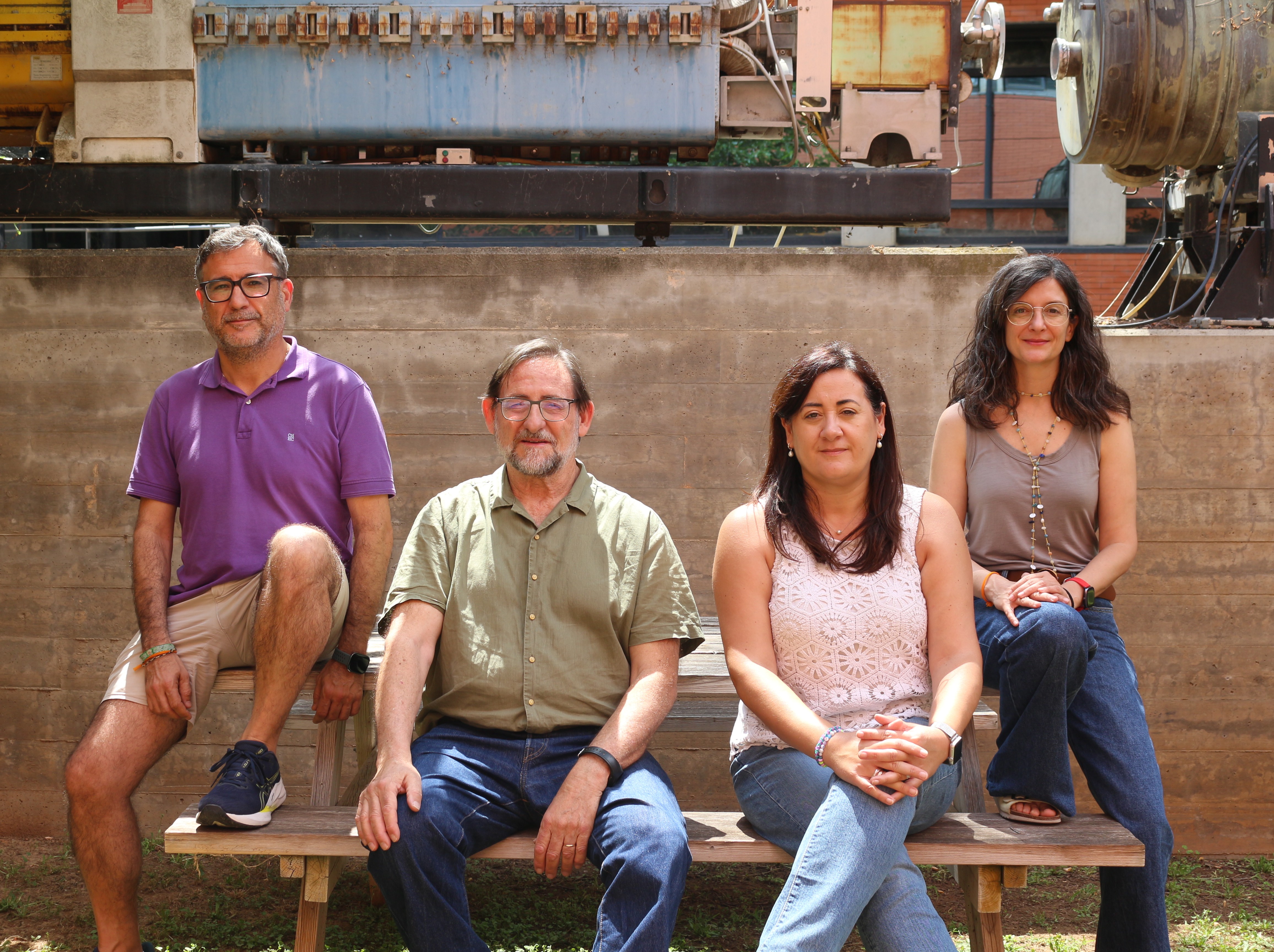
From left to right: Santiago González, José Salt, Mariam Tórtola, and Emma Torró.