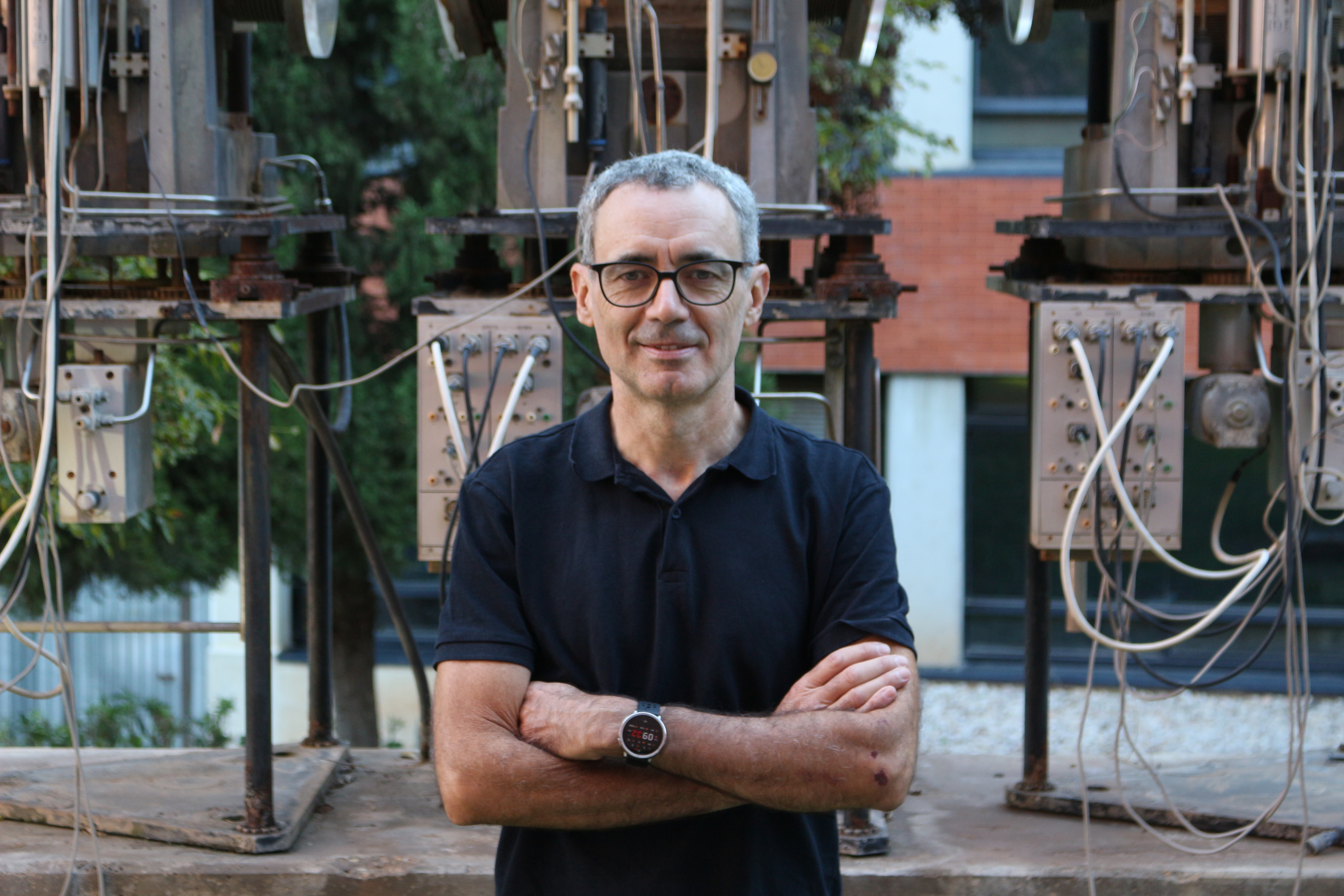




IFIC researcher César Domingo Pardo receives the RSEF–BBVA Foundation Physics, Innovation and Technology Prize
César Domingo Pardo, a scientific researcher at the Institute for Corpuscular Physics (IFIC), a joint centre of the Spanish National Research Council (CSIC) and the University of Valencia (UV), has been awarded the Physics, Innovation and Technology Prize by the Royal Spanish Society of Physics (RSEF) and the BBVA Foundation.
The RSEF–BBVA Foundation Physics, Innovation and Technology Prize is one of the categories of the Physics Awards jointly presented by the Royal Spanish Society of Physics (RSEF) and the BBVA Foundation. The BBVA Foundation has supported these awards since 2008, although the RSEF awards themselves date back to 1958. This category is specifically intended to recognise research in physics that has led to advances in technological innovation or promoted the application of physics in business and business development. In particular, it is awarded to researchers or entrepreneurs who have contributed to bringing knowledge and results from physics into the fields of technological and/or business innovation in Spain. These awards recognise careers that combine excellence in basic research with the ability to transfer advances to society and industry.
Domingo has led the transfer of advanced gamma-ray detection technology to industry. This methodology, originally developed for astrophysics and nuclear physics experiments at CERN, has been applied in practical applications in strategic sectors such as nuclear power plant decommissioning and cancer proton therapy.
César Domingo is a researcher at IFIC, where he develops ultra-high-sensitivity radiation detection instrumentation, which he uses in experiments at CERN’s n_TOF facility to investigate a fundamental question: how heavy elements are formed in stars. This technology, originally developed for nuclear astrophysics, has become the basis for a wide range of applications, including imaging systems for accurately guiding cancer hadron therapy treatments, a new real-time dosimetry device for boron neutron capture therapy (BNCT), and tools for nuclear power plant decommissioning and the characterisation of radioactive waste, in collaboration with ENRESA.
Domingo led the HYMNS project, funded by an ERC Consolidator Grant (2016–2022), through which the i-TED (Total-Energy Detector with imaging capability) was developed. The device made it possible, for the first time at CERN, to carry out experimental studies of key reactions involved in stellar nucleosynthesis. This work contributes directly to understanding the fundamental building blocks of the universe and its evolution. Building on HYMNS, he was awarded two ERC Proof of Concept grants (AMA and GNVISION), focusing on applications in hadron therapy.
In this case, the jury of the RSEF–BBVA Foundation Physics, Innovation and Technology Prize particularly highlighted the coherence of a career that has successfully connected fundamental physics with concrete advances in fields as diverse as healthcare and nuclear safety.
“For me, it is very rewarding to see how developments and technologies that were originally created to better understand stars and the universe can ultimately be successfully transferred to other fields, having a positive impact on people’s health and well-being,” says Domingo. “This award recognises precisely that journey, and I hope it will also encourage other research groups to seek ways of generating a positive impact on society.”